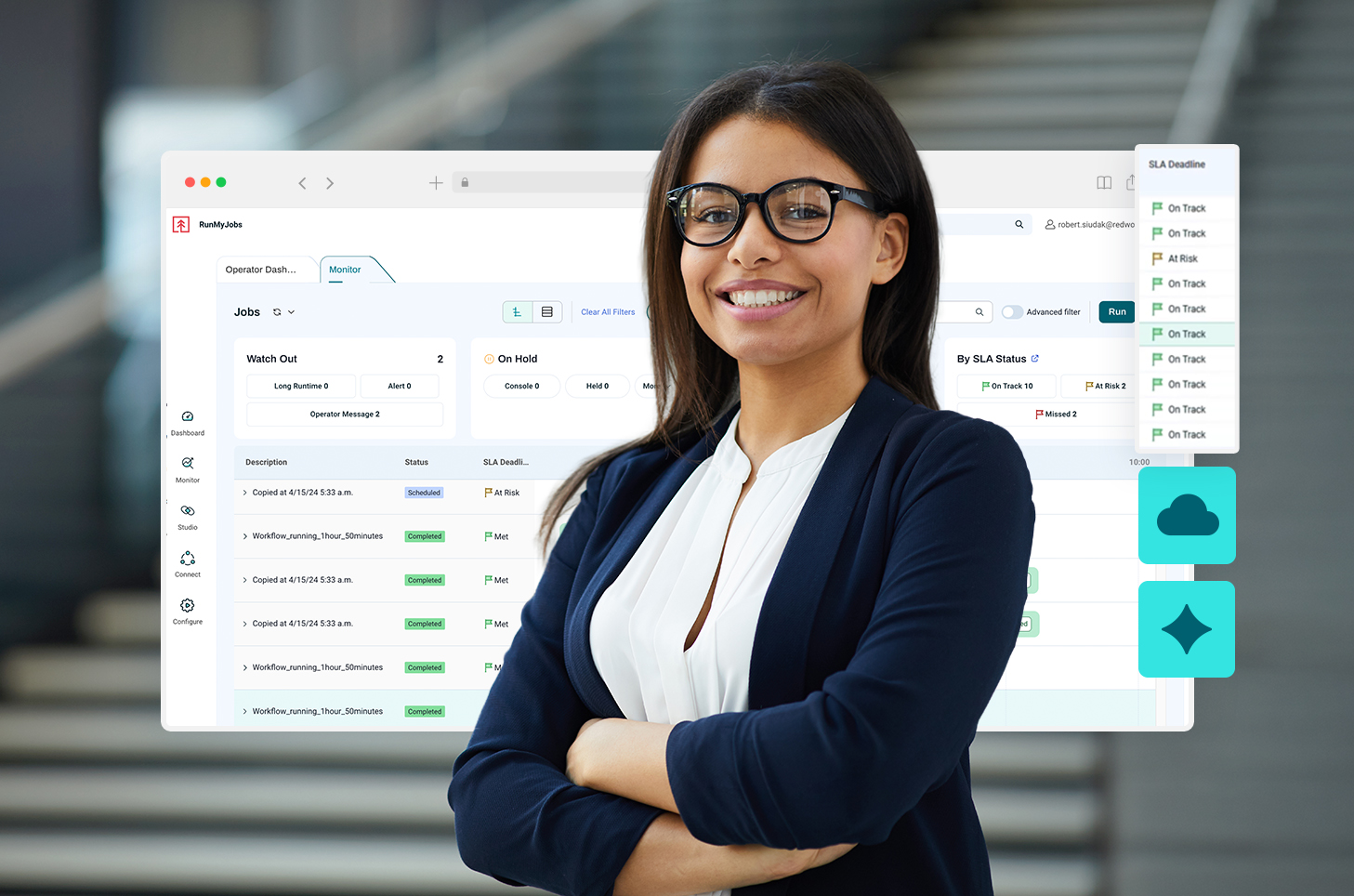
The blind spots blocking hybrid cloud resilience
Hybrid cloud IT operations span dozens of dependencies across legacy schedulers, cloud-native services and modern data pipelines. Without real-time visibility across all of them, IT operations teams are always one cascading failure away from a business outage — and the last to know it happened.
-

Cross-system dependencies hidden by tool sprawl
Legacy schedulers, cloud-native services and open-source orchestrators run in silos. When something breaks, your team has no single view of what triggered it, and the bottlenecks in diagnosing it cost hours you don’t have.
-

Cascading failures your monitoring tools miss
A delayed batch job, a stalled queue or a slow API can ripple into a business outage. Disruptions can reach your customers before your monitoring tools catch them.
-

Ungoverned services that accumulate with every migration
Lift-and-shift environments and modern cloud workloads coexist without a shared SLA lens. Every new service you add is another failure point with no owner and no automated remediation path.
-

Compliance and audit trails no one can trace
Custom scripts, open-source tooling and siloed cloud services make compliance, audit trails and IT service management (ITSM) impossible to enforce at scale.
Today’s enterprise hybrid cloud demands a different kind of orchestration
RunMyJobs by Redwood is the AI-powered Service Orchestration and Automation Platform (SOAP) designed to streamline and automate hybrid cloud IT operations at enterprise scale.
-

AI for the automation lifecycle
AI embedded at every stage, from workflow development to SLA monitoring, troubleshooting and automated remediation
-

Enterprise-grade SaaS
99.95% uptime, SOC 1 and 2 Type II certified and scalability across seven global regions with built-in disaster recovery
-

Agentless architecture
Instant deployment and zero-disruption upgrades in minutes — no agents, no VMs, no patching
-

Open and extensible platform
Pre-built connectors for SAP, AWS, Azure, ServiceNow, Databricks and more, plus no-code tools for custom integrations
-

30+ years of automation expertise
50 billion+ automations executed annually for 50% of the Fortune 50’s most mission-critical operations
-

SAP-endorsed automation
The only SOAP solution in the RISE with SAP reference architecture, with 20+ years of deep SAP partnership and native connectivity
Take AI and IT operations automation from reactive to resilient
AI changes how IT operations teams work, shifting from reacting to failures to automatically preventing them. RunMyJobs embeds AI across the entire process automation lifecycle, giving operations teams the visibility and intelligence to keep hybrid cloud environments running without constant manual intervention.
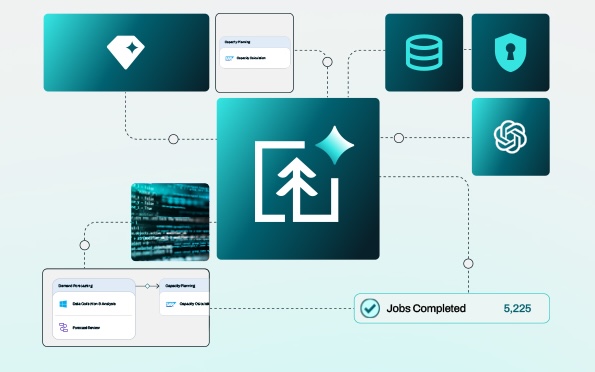
Powered by AI at every stage
RunMyJobs applies AI where it has the most operational impact. During workflow development, the Redwood RangerAI Automation Co-pilot generates scripts and documentation so IT teams build faster and with fewer errors.
In production, predictive SLA monitoring uses machine learning to compare live execution against historical performance, flagging at-risk workflows before they breach deadlines. When something goes wrong, the Redwood RangerAI Product Assistant analyzes the failure context and surfaces the most likely fix, cutting the time between alert and resolution.
Across all stages, AI reduces the manual intervention that slows IT operations teams down and increases the risk of human error in complex hybrid environments.
-

Reduce downtime
Automated recovery workflows restart, reroute or escalate failing jobs before outages reach the business, so your mean time-to-resolution (MTTR) drops — not your SLAs.
-

Improve SLA attainment
AI-powered predictive monitoring uses real-time data to identify at-risk workflows before they breach deadlines, keeping critical IT processes on schedule.
-

Accelerate incident response
The Redwood RangerAI Product Assistant delivers context-aware troubleshooting at the point of failure, cutting MTTR and keeping incidents from becoming outages.
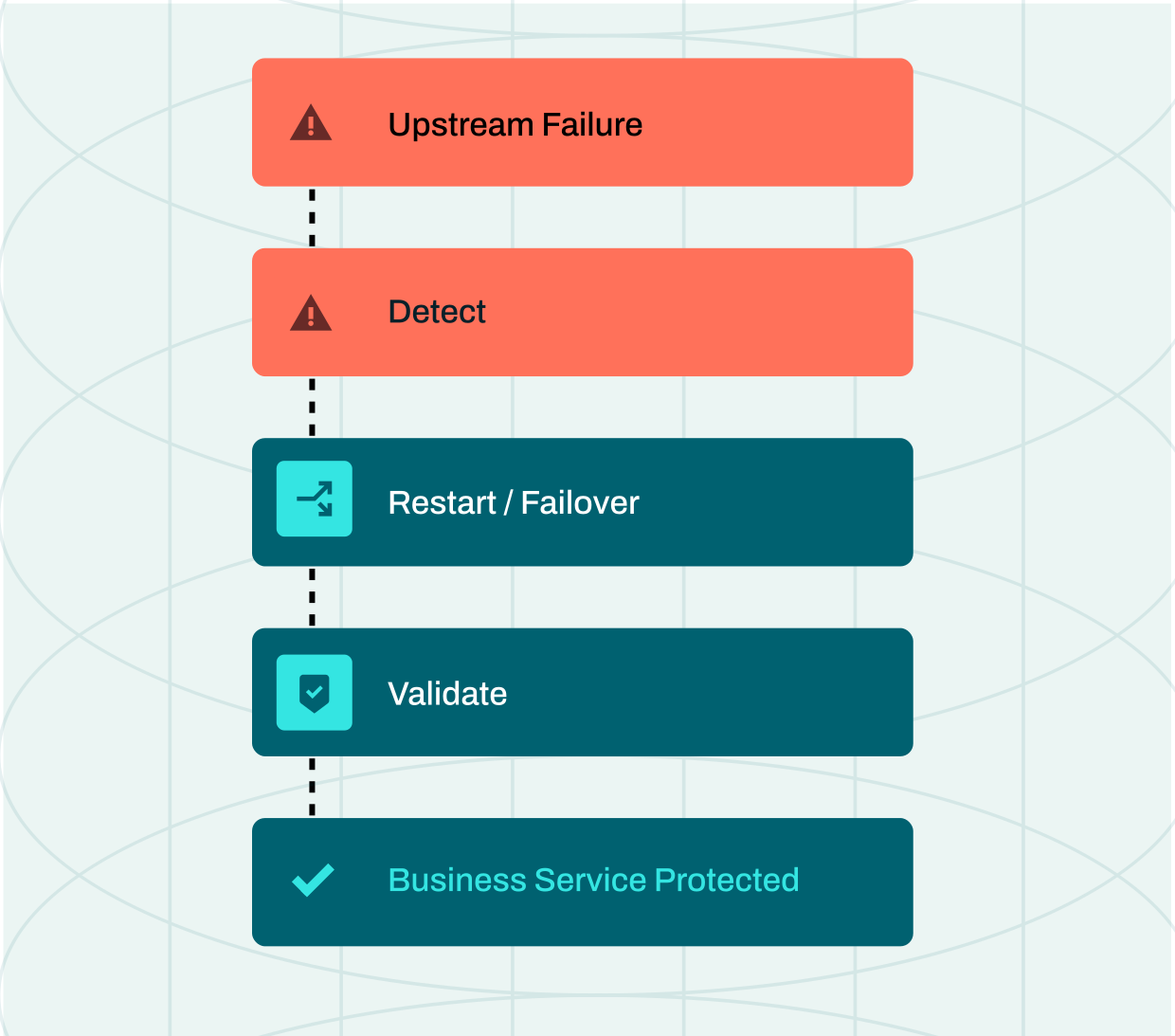
Act on outages before they leave the IT environment
When RunMyJobs detects an upstream problem threatening a downstream business outcome, it doesn’t wait for human intervention. It automatically restarts failed jobs, reroutes automated workflows around the failure point or runs compensating workflows to maintain service continuity.
Where human judgment is needed, it escalates with full context — the job history, the dependency chain, the business service at risk — so the right person can act immediately rather than spend time diagnosing.
For IT operations teams managing hundreds of interdependent workflows across legacy and cloud environments, this is the difference between a failure that resolves itself at 2 AM and a war room that runs until morning.
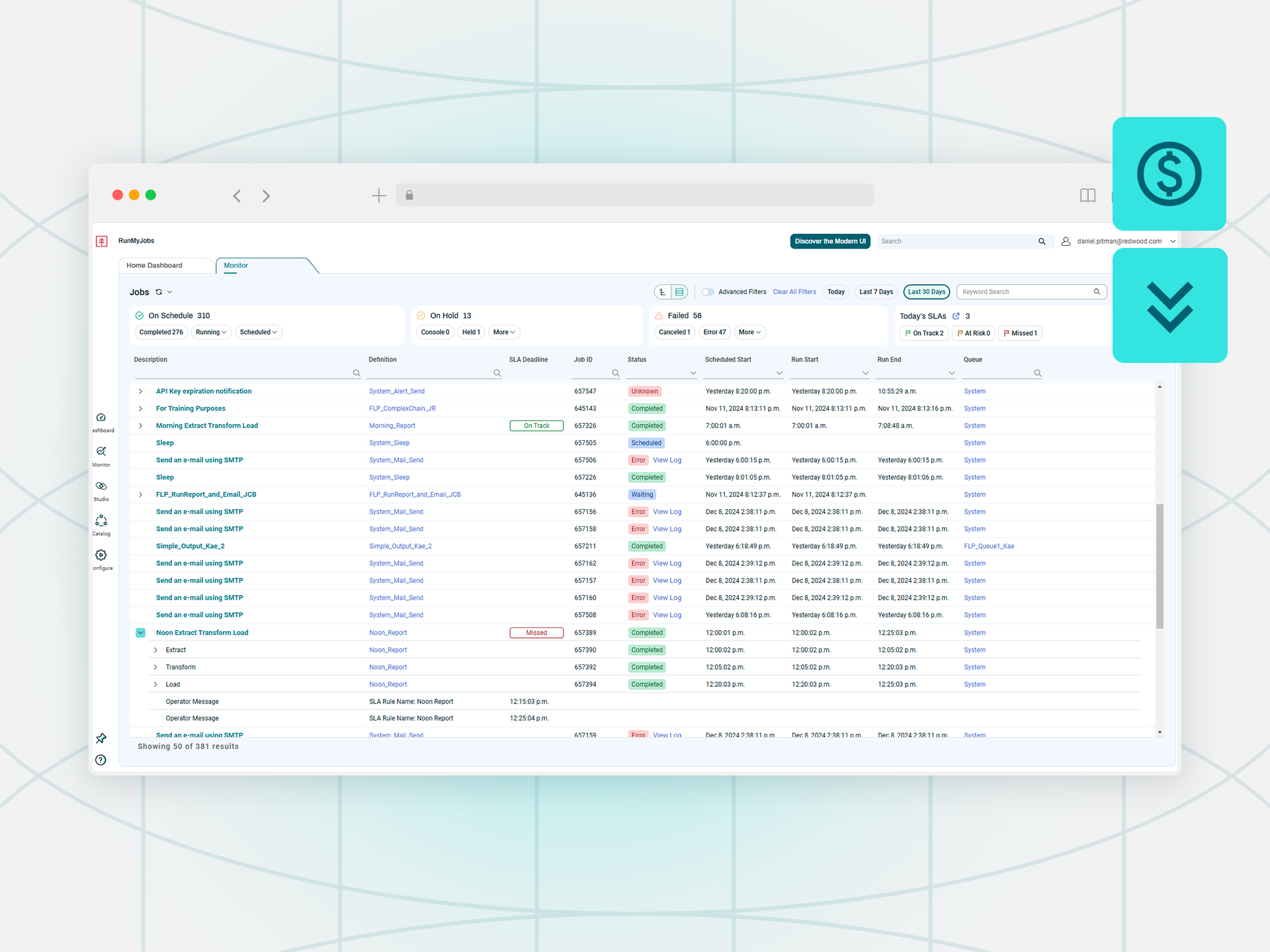
Reduce operational costs by eliminating islands of automation
Stop paying for the complexity you built by accident. Replace expensive, self-hosted legacy schedulers and custom scripts with an enterprise-grade SaaS platform made for continuous optimization — and redirect those cost savings toward the work that moves your business forward.
- Zero maintenance: Manage your global automation footprint without patching servers, databases or VMs.
- Reduced tool sprawl: Scale instantly and reduce your security attack surface by removing the need for local agent management.
- Predictable costs: Eliminate unplanned expenses from audits, overages and heavy customization through transparent commercial terms.
Trusted by global enterprises running mission-critical operations
-

99.95% uptime
Industry-leading SLA
-

50 billion+ annual automations
Executed globally
-

8,000+ customers
Across every major industry
One platform for every hybrid cloud use case
Hybrid cloud modernization isn’t a single initiative. RunMyJobs supports the full range of enterprise digital transformation programs, from application migrations to ERP integrations to disaster recovery, on a single orchestration platform.
-
Use case
Event-driven orchestration
Build ReliabilitySynchronize legacy batch and real-time cloud services so digital business processes run on time, every time.
-
Use case
Cloud migration and modernization
Modernize SmarterOrchestrate legacy and refactored workloads in parallel so modernization stays on schedule and on budget.
-
Use case
ERP and SaaS
Upgrade ERP AutomationGovern dependencies between SAP, Oracle and cloud applications with pre-built connectors and impact analysis.
-
Use case
Disaster recovery and business continuity
Protect the BusinessAutomate failover orchestration with dependency mapping and policy-driven recovery so services meet RTO targets.
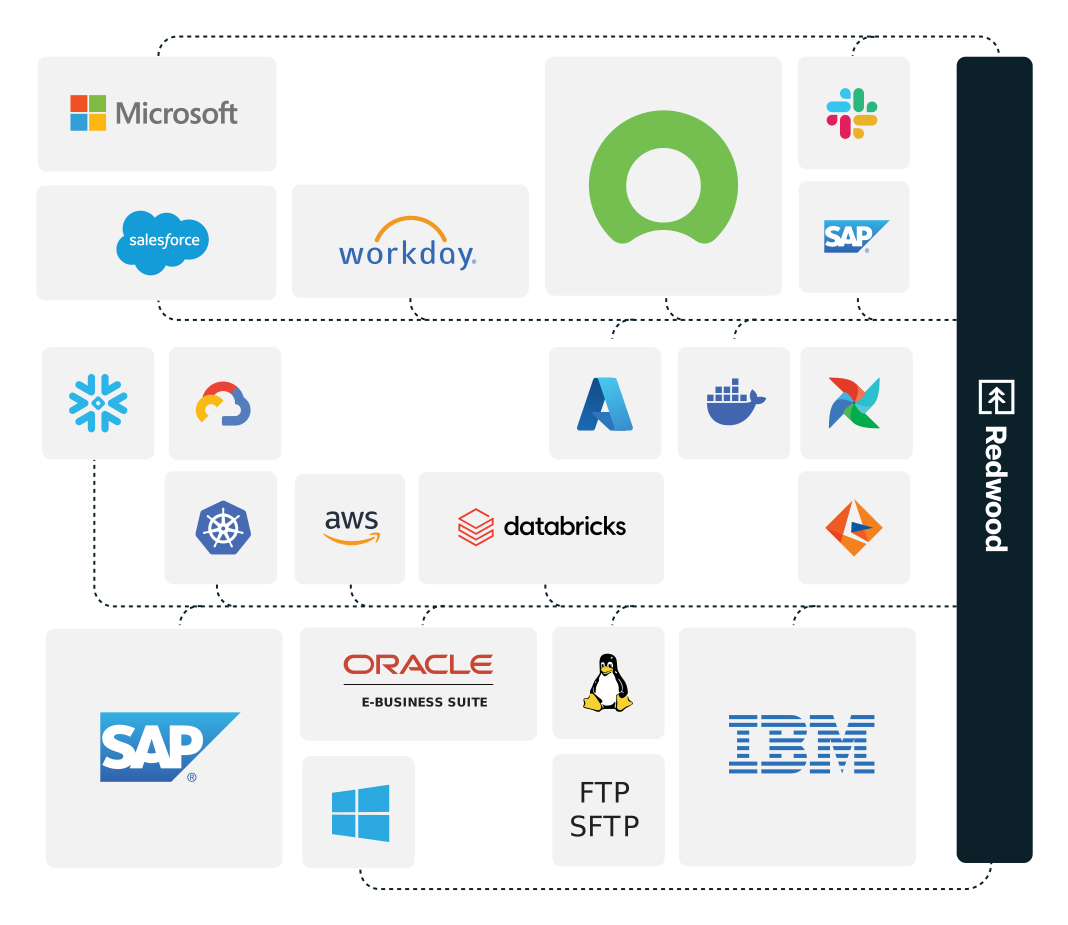
Connect and scale across your stack
RunMyJobs connects to the tools your enterprise already runs — out of the box, without custom code. From legacy ERP systems to modern cloud platforms, manage every integration through a single orchestration control plane.
- Cloud platforms and hyperscalers
- Data and analytics platforms
- ERP and enterprise applications
- ITSM and DevOps platforms
Go deeper: Automation and AI for IT operations
Dig into research, guides and expert perspectives on automation and AI.



ITOps and AIOps FAQs
What is IT operations automation?
IT operations automation is the use of software to execute, monitor and manage IT processes, such as job scheduling, incident management, patch management, provisioning and routine tasks, without requiring constant manual intervention. In practice, this means IT teams can define rules, dependencies and escalation paths once, then let the automation platform handle execution across their entire IT infrastructure.
The goal is to reduce human error, eliminate time-consuming manual processes, and free IT staff to focus on strategic initiatives rather than keeping the lights on. As IT environments grow more complex — spanning on-premises systems, private cloud and public cloud — IT operations automation becomes the connective tissue that keeps workflows running reliably across silos.
How does IT operations automation work in a hybrid cloud environment?
In a hybrid cloud environment, IT operations automation works by providing a unified orchestration layer that connects on-premises systems, private cloud infrastructure and public cloud services into a single, manageable control plane. Rather than managing automated workflows separately in each environment — with different automation tools, schedulers and monitoring systems — teams use a single automation platform to define dependencies, trigger events and enforce SLAs across all environments at once.
When a business process spans both a legacy ERP system and a cloud-based SaaS application, for example, the orchestration platform tracks every step, detects when something is at risk and can automatically reroute or restart workflows before disruptions reach the business.
Real-time dependency visibility is what makes this possible. Without it, failures in one environment cascade silently into others. IT operations automation in hybrid cloud also supports self-healing workflows, where the system detects anomalies, triggers remediation automatically and escalates only when human judgment is genuinely needed, reducing mean time to resolution and protecting operational efficiency.
What is the difference between IT operations automation and AIOps?
IT operations automation and AIOps address related problems, but they operate at different layers. IT operations automation focuses on reliably executing and managing IT processes: scheduling jobs, orchestrating workflows, handling incident response and enforcing dependencies across IT systems. It answers the question: “How do we make sure the right things happen in the right order, every time?”
AIOps, short for artificial intelligence for IT operations, applies machine learning and AI-powered analytics to the data generated by those operations. It uses observability data, metrics and event streams to detect anomalies, perform root-cause analysis and surface actionable insights that help IT operations teams act faster. Think of IT operations automation as the execution engine and AIOps as the intelligence layer that makes it smarter.
In practice, the most effective modern automation platforms combine both. Automated workflows handle the execution, while AI-driven monitoring and decision-making capabilities detect risks, predict failures and guide troubleshooting, so IT teams spend less time on repetitive tasks and more time on the work that actually moves the business forward.
Are there automation solutions that support both finance and IT operations?
Yes. Automation solutions that operate at the orchestration layer, instead of automating a single department’s tasks, can support finance and IT operations from the same platform. This matters because many finance processes, such as financial close or reporting, depend on IT systems running on schedule, so separating the two into different tools creates blind spots when something fails.
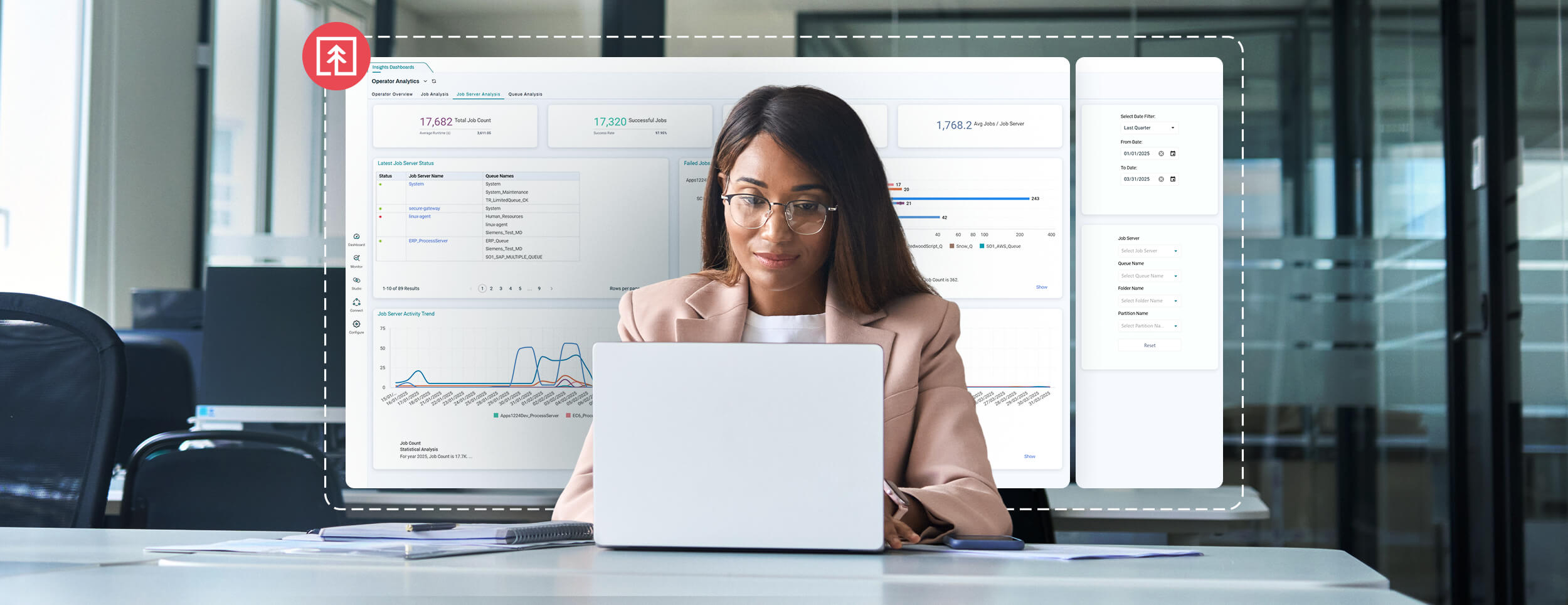
RunMyJobs by Redwood is built to work across both domains by automating IT tasks like server maintenance and job scheduling alongside finance processes like record-to-report and journal entry automation via its Finance Automation by Redwood integration. Teams get one dashboard for monitoring dependencies across finance and IT, which shortens the time it takes to find and fix a problem before it affects the business.