What is agentic AI — and why does it require orchestration?
Agentic AI describes AI agents that pursue a goal autonomously, reasoning through problems, choosing actions and adjusting as conditions change, rather than following a fixed script. Orchestration is what lets that reasoning safely touch your enterprise systems: your ERP, data pipelines and the workflows your business depends on every day. As multi-agent systems become more common, that orchestration layer becomes the difference between AI that experiments and AI that executes.
Use agentic orchestration to expand your existing automation
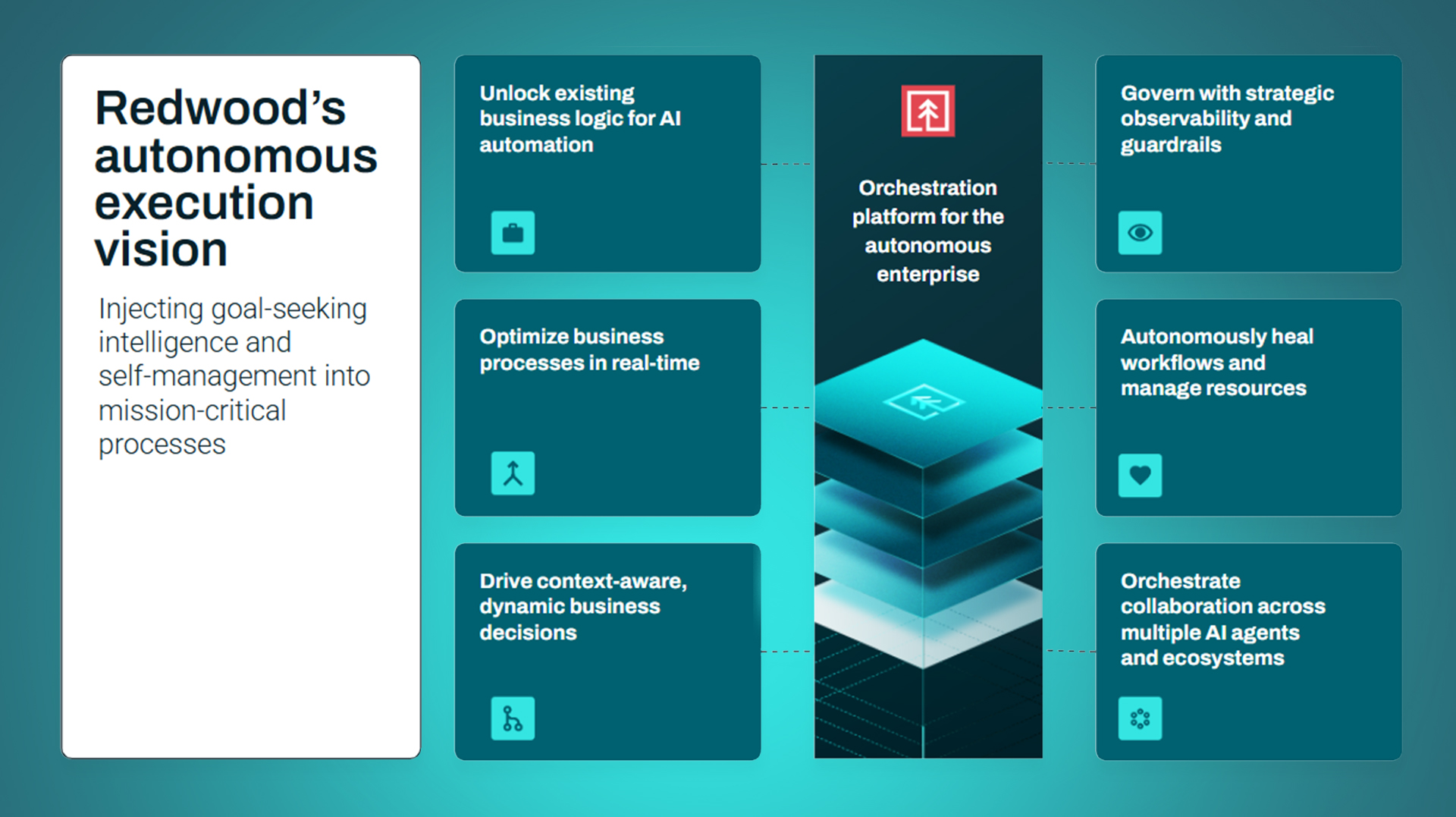
Why governed agentic orchestration is the enterprise imperative
Reliable automation took years to build. Connecting AI agents to those same processes without introducing risk, complexity or ungoverned behavior is where most enterprises are stuck right now.
-

Governance gaps slow AI adoption
70% of leaders cite lack of governance as their primary barrier.*
-
Data isn’t ready for AI
80% of IT leaders say their data infrastructure isn’t prepared.*
-
Fear of disruption stalls progress
Integrating AI without breaking existing systems remains the top concern.
-
Ungoverned agents multiply unchecked
“Shadow AI” creates compliance exposure and audit gaps across the enterprise.
-
Expertise is hard to find
A shortage of AI skills leaves most organizations unable to scale projects.
-
Deployment remains rare
Only 16% of organizations have deployed agentic AI.*
* Gartner Innovation Guide for AI Agents 2024, Gartner CIO and Technology Executive Survey
Moving from pilots to everyday operations at scale
Pilots prove the concept. These use cases show what governed agentic AI looks like when it’s running the fundamental business process automation that matters day to day.
Challenge
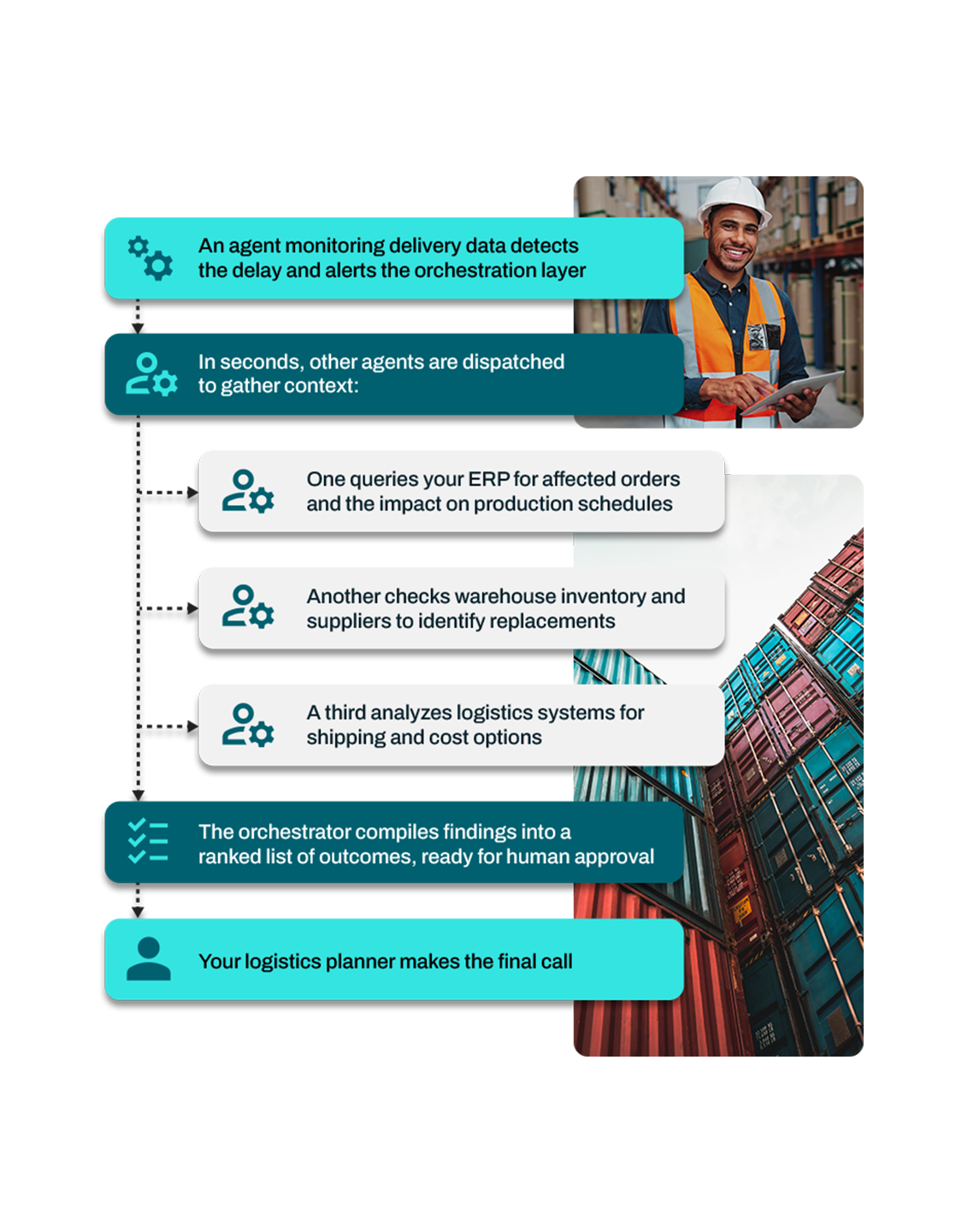
A shipping delay forces planners to manually investigate orders, inventory and logistics data across multiple systems before they can determine the best response. This process can take hours or days.
AI orchestration
Agentic AI analyzes the disruption, gathers context from ERP, inventory and logistics systems and presents ranked response options, while keeping execution governed and aligned with your business processes.
Business outcome
Disruption response shrinks from hours to minutes because the agent absorbs the investigation and your planners act on ranked options, not raw data.
Challenge
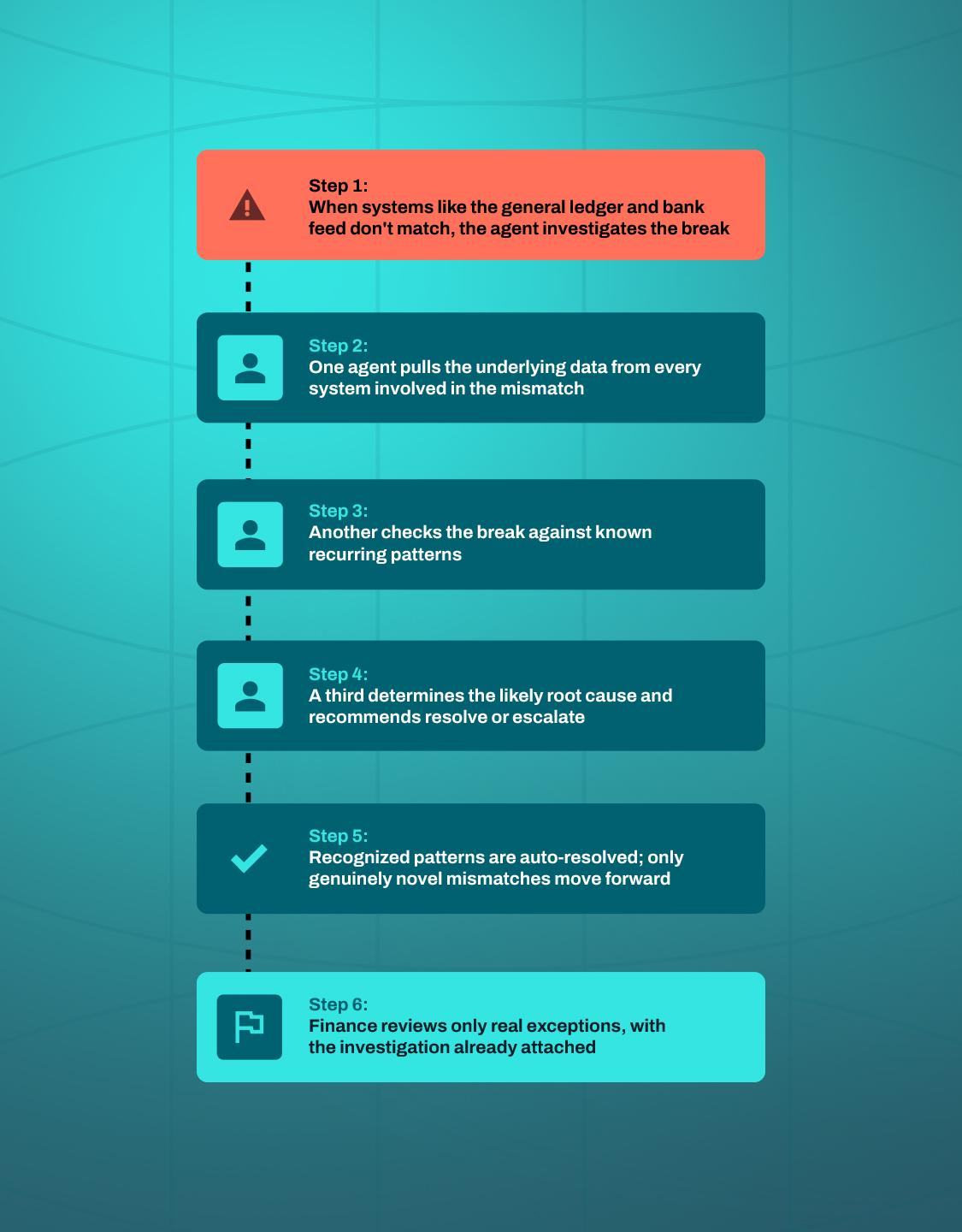
When systems like the general ledger and bank feed don’t match, someone has to manually trace the discrepancy across every system involved, determine the root cause and decide whether to resolve or escalate.
AI orchestration
Agentic AI checks the same upstream systems a human would, proposes the likely cause, automatically resolves recognized recurring patterns and escalates only genuinely novel mismatches — with the full investigation already attached.
Business outcome
Break resolution gets faster as volume grows, because the agent handles the investigation and your team handles only what genuinely requires judgment.
Challenge
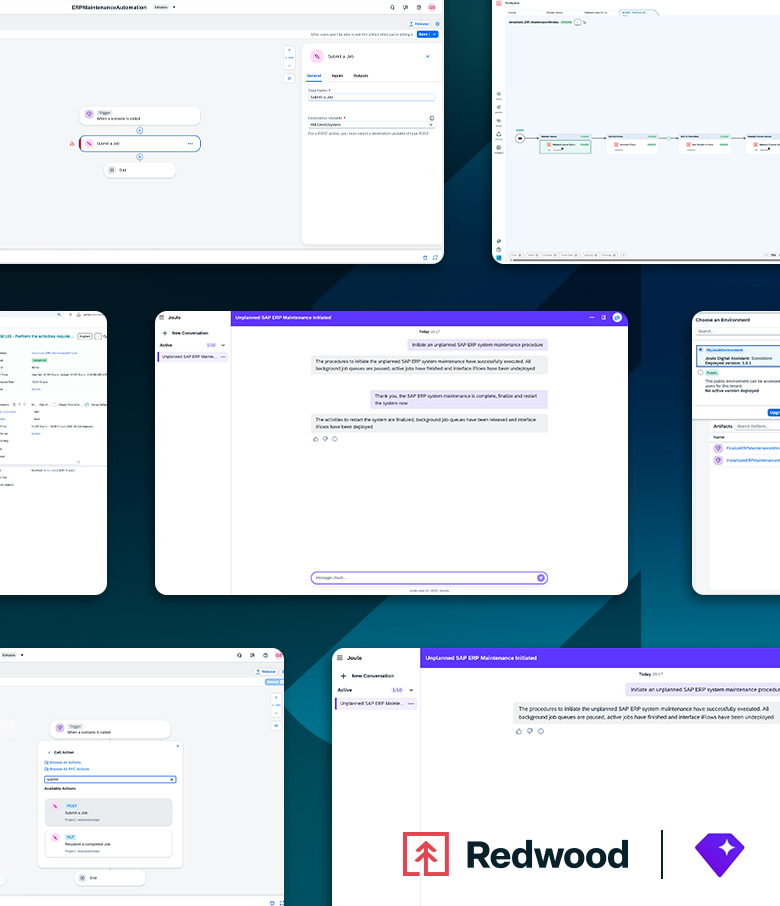
Managing SAP workflows, approvals and system maintenance across multiple teams and applications often depends on manual coordination, slowing response times and increasing the risk of errors.
AI orchestration
Agentic AI works alongside enterprise automation to coordinate SAP processes, streamline complex workflows and connect intelligent decision-making with governed execution.
Business outcome
Manual coordination shrinks as the agent connects workflows across SAP systems, so your team spends less time orchestrating handoffs and more time on higher-value work.
You need more than intelligence
Answering questions is straightforward. The hard work is executing across the systems and applications your business depends on; this is enterprise-ready AI.
-

AI must work across a hybrid enterprise
Enterprise work spans ERP, HR, finance, cloud and data platforms. AI needs governed connectivity across all of them.
-

AI needs to execute reliably every time
Business processes can’t pause for unexpected AI behavior. Reliable execution keeps critical workflows stable while allowing you to achieve greater scalability.
-

AI has to be observable
AI operating outside your security policies and audit requirements creates risk at scale. Governance has to be built in, not added later.
-

AI should enhance what you already have
Most organizations already have automation, integrations and workflows in place. AI should extend those investments, rather than displacing them.
RunMyJobs by Redwood
The orchestration layer for every system and every agent
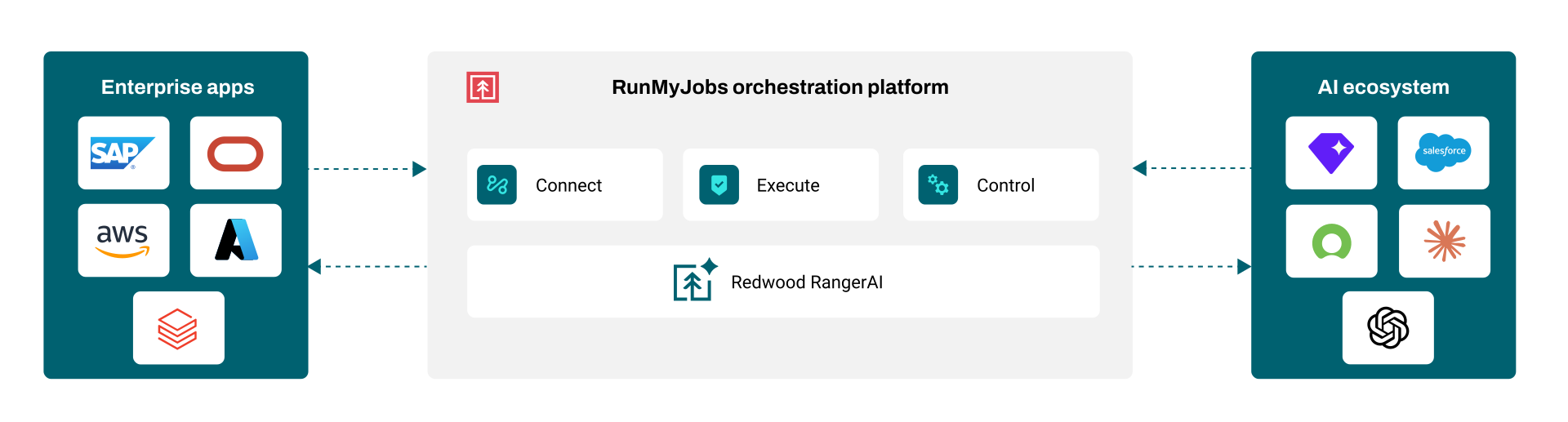
Start putting agentic AI to work
From governed AI workflows to natural language execution, RunMyJobs turns agentic AI from a concept into a running business process.
-
Governed agentic orchestration
Get a Closer Look at Agentic OrchestrationMove AI agents out of pilots and into the workflows your business already runs, with governance, auditability and control built in from the start.
- Govern every agent action with full auditability
- Extend existing automation with intelligent agents
- Scale autonomous business processes
-
Zero-code AI connectivity
More About RunMyJobs’ MCP ServerThe Model Context Protocol (MCP) gives any compatible AI agent governed, zero-code access to your RunMyJobs automation estate, with full observability across every interaction.
- Connect any compatible AI agent without custom integrations
- Deploy across nine global AWS regions
- Authenticate every AI interaction with OAuth 2.0 and full audit traceability
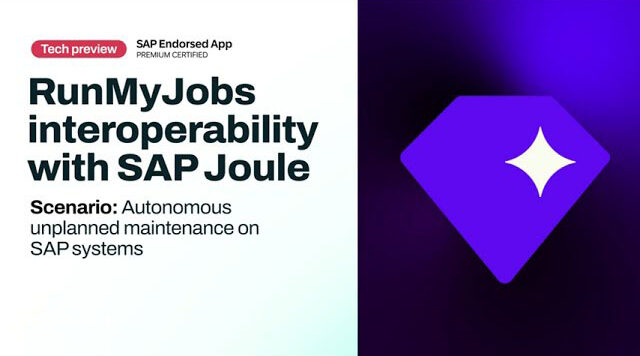

Natural-language execution
RunMyJobs interoperates with SAP’s Joule to coordinate complex SAP workflows through governed enterprise automation.
- Trigger RunMyJobs workflows directly from Joule
- Turn conversational requests into enterprise execution
- Control complex SAP workflows end to end
How AI is taking hold across industries
Explore research, guides and insights on AI and automation adoption.

Industry report
Manufacturing AI and automation outlook 2026
98% of manufacturers are exploring or considering AI-driven automation, yet only 20% are fully prepared to use it at scale. New research reveals the structural challenges, from manual exception handling to fragmented execution, that limit AI readiness — and automation ROI.




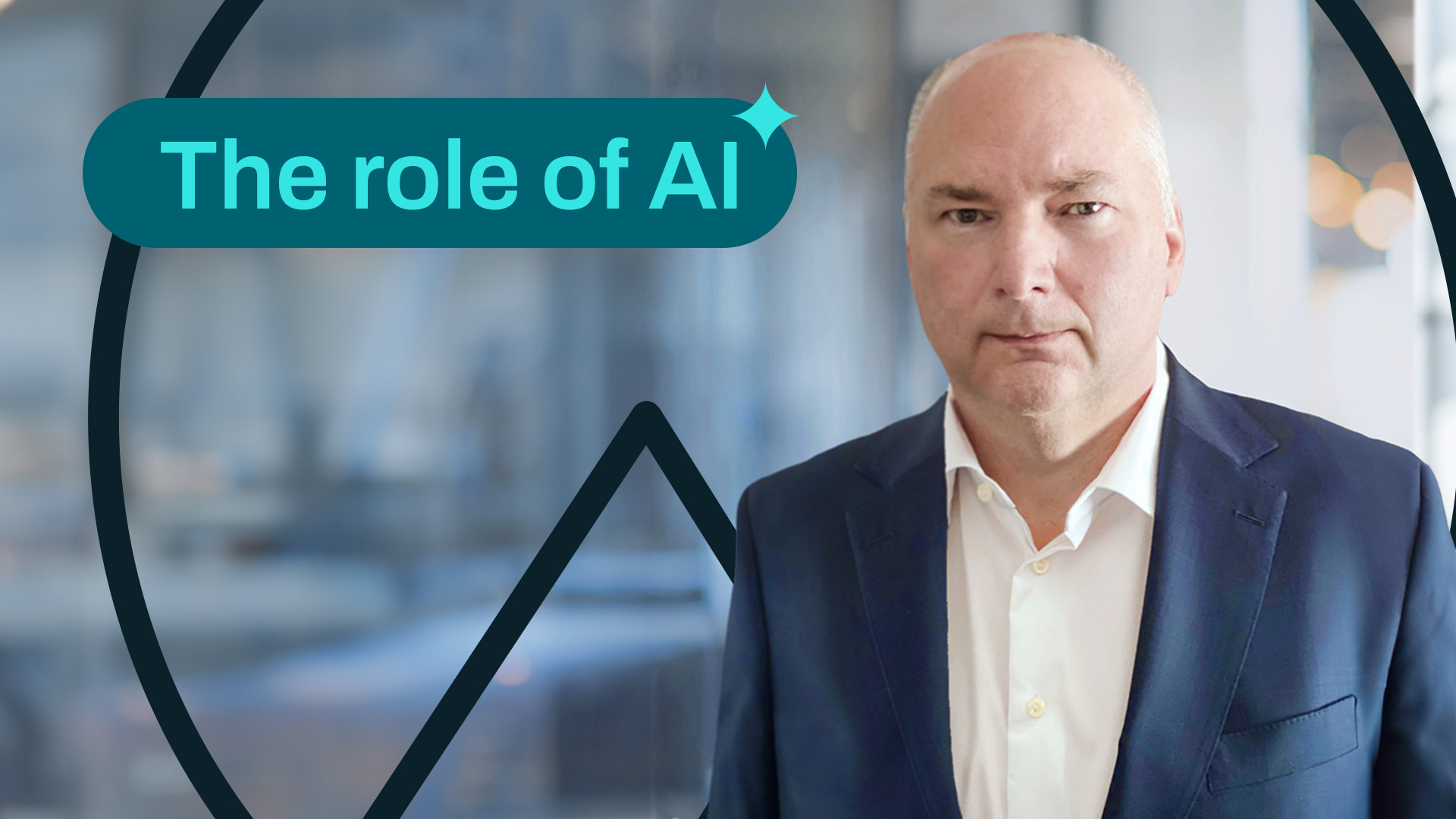
AI orchestration in practice
Redwood’s Chief Product Officer, Charles Crouchman, explores real-world AI use cases, agentic AI orchestration and practical steps for adopting AI in enterprise automation.
Learn the fundamentals
Build your understanding of agentic AI, enterprise orchestration and the technologies shaping the autonomous enterprise.



Go deeper
Explore how agentic AI is reshaping workload automation and enterprise orchestration.



Bridge ChatGPT and your enterprise automation
Orchestration closes the distance between a ChatGPT response and a running business process. RunMyJobs does this without sacrificing governance or visibility.
- Turn unstructured AI responses into governed workflows
- Automate structured repetitive tasks like report generation and data entry without losing governance
- Maintain traceability with real-time audit trails
Latest insights
Stay current on agentic AI, enterprise orchestration and the automation strategies shaping how leading organizations operate.



Agentic AI FAQs
How does orchestration work in agentic AI?
Orchestration governs how autonomous AI agents access enterprise systems, manage state, handle errors and escalate to human-in-the-loop checkpoints when a decision requires oversight, turning agent reasoning into reliable, auditable business execution. Where traditional automation handles structured repetitive tasks like data entry, report generation and invoice processing, orchestrated agents handle the exceptions, decisions and cross-system coordination those tools weren’t built for.
RunMyJobs by Redwood provides that orchestration layer for the enterprise, connecting AI agents to your existing workflows and automation estate while keeping every action governed, traceable and auditable.
See how RunMyJobs and SAP’s Joule are changing how work gets done.
What are the 4 steps of agentic AI?
Agentic AI operates through four steps:
- Perceive
- Reason
- Act
- Learn
An agent perceives context from connected systems, including unstructured data and real-time inputs, reasons through a goal using large language models (LLMs) and other foundational AI models, acts across enterprise applications and learns from outcomes through reinforcement learning to improve over time.
Build the orchestration foundation every enterprise needs.
What is the difference between workflow orchestration and agentic AI?
Workflow orchestration executes predefined, deterministic sequences across enterprise systems. Agentic AI goes further: autonomous agents use natural-language processing and machine learning to reason about a goal, adapt mid-execution and handle exceptions without human intervention. This makes agentic AI particularly valuable in contexts where decisions involve unstructured inputs, data privacy considerations or cybersecurity risk — scenarios where rigid, rule-based automation falls short and where chatbots and basic AI assistants lack the execution capability to follow through.
Find out how workload automation is evolving toward autonomous execution.
More on AI innovation
Get practical perspectives on agentic AI, enterprise orchestration and the standards shaping how AI connects to the systems your business runs on.