Joule is ready to act. Are your systems ready to execute?

SAP Sapphire 2026 will be underway starting next week, and as in past years, Joule has been central to nearly every conversation about the future of enterprise AI. That’s no surprise. Since its official announcement in September 2023, Joule has evolved from a conversational copilot into a genuinely agentic system that can reason through multi-step workflows, coordinate across SAP applications and initiate action rather than simply respond to prompts.
The industry trajectory behind this shift is well-documented. The November 2022 launch of ChatGPT accelerated enterprise AI adoption faster than most anticipated, moving organizations from isolated experimentation to embedding AI directly into daily business operations. Analysts at Gartner and Forrester now converge on the same conclusion: the near-term future of enterprise AI is defined by the transition from passive, prompt-based assistants to autonomous AI agents capable of goal-driven execution.
Joule Agents represent SAP’s answer to that transition. With Agent Builder in Joule Studio, development teams can now design context-aware agents that plan, reason and execute multi-step workflows across SAP and non-SAP systems, building on earlier co-innovation between Redwood Software and SAP.
But the capability to act and the infrastructure to execute and scale reliably are two different things.
When Joule acts, something has to execute
The maintenance window is a solid use case to examine that gap, because it exposes exactly where agentic intent meets operational complexity.
Consider an unplanned SAP system maintenance window. Traditionally, this requires multiple manual steps and cross-team coordination: pausing background jobs, stopping dependent integrations, managing approvals and verifying that dependencies are resolved before maintenance can proceed. The SAP Business Technology Platform (BTP) team handles iFlows. The Basis team manages job suspension separately. Each manual handoff introduces risk, and as SAP landscapes become more interconnected, that complexity only increases.
With RunMyJobs by Redwood integrated into Joule, a Basis administrator can take a goal-oriented approach instead. They express intent — preparing systems for a maintenance window — and Joule handles the conversational layer, understanding the request and applying business context. RunMyJobs handles execution: orchestrating the required actions across SAP and connected systems using predefined workflows, policies and controls that have already been defined, approved and governed.
In other words, Joule is responsible for understanding and interacting while RunMyJobs is responsible for deterministic, auditable execution. Every step that runs has been scoped in advance. What changes is how teams interact with automation, but not the rigor with which it operates.
Conversational and agentic AI alone aren’t sufficient for enterprise automation. Without a reliable orchestration layer, AI initiatives introduce risk into mission-critical processes. RunMyJobs acts as the control plane between conversational intent and system execution. It’s cloud-native, an SAP Endorsed App and the only workload automation and orchestration platform that’s part of the RISE with SAP reference architecture. It provides centralized scheduling, dependency management, execution and observability across complex SAP and non-SAP landscapes, with role-based access control (RBAC), enforced approvals and a complete audit trail for every action taken.
For a closer look at how this integration was designed and what it demonstrates, see how Redwood and SAP are shaping the next era of automation with Joule Studio.
Unlocking business value from Joule with RunMyJobs
Building Joule integrations with RunMyJobs just became significantly more accessible.
RunMyJobs’ REST API and pre-built SAP Build Actions are now published in the SAP Business Accelerator Hub, which has a few practical implications for teams building on SAP BTP. Development teams building Joule skills and agents can invoke RunMyJobs’ orchestration capabilities directly as no-code components within Joule Studio — no custom integration work required — with the full REST API accessible as low-code components for more advanced scenarios.
Inclusion in the Accelerator Hub also reflects a deeper level of alignment with SAP, as these integrations are designed within SAP’s extension framework and consistent with clean core principles and SAP BTP development standards. Furthermore, for customers with high security requirements, RunMyJobs now supports OAuth from SAP BTP, including Joule, to its REST API.
The integration is genuinely bi-directional: RunMyJobs can trigger and orchestrate SAP Build Process Automation workflows as part of larger end-to-end business processes, while SAP Build applications and workflows can call RunMyJobs capabilities — raising and clearing events, responding to alerts, managing queues — directly from within the SAP BTP ecosystem. And Joule can incorporate RunMyJobs as part of AI-driven automation scenarios, using it as the governed execution layer for Agents and Skills that need to operate reliably across SAP and non-SAP systems.
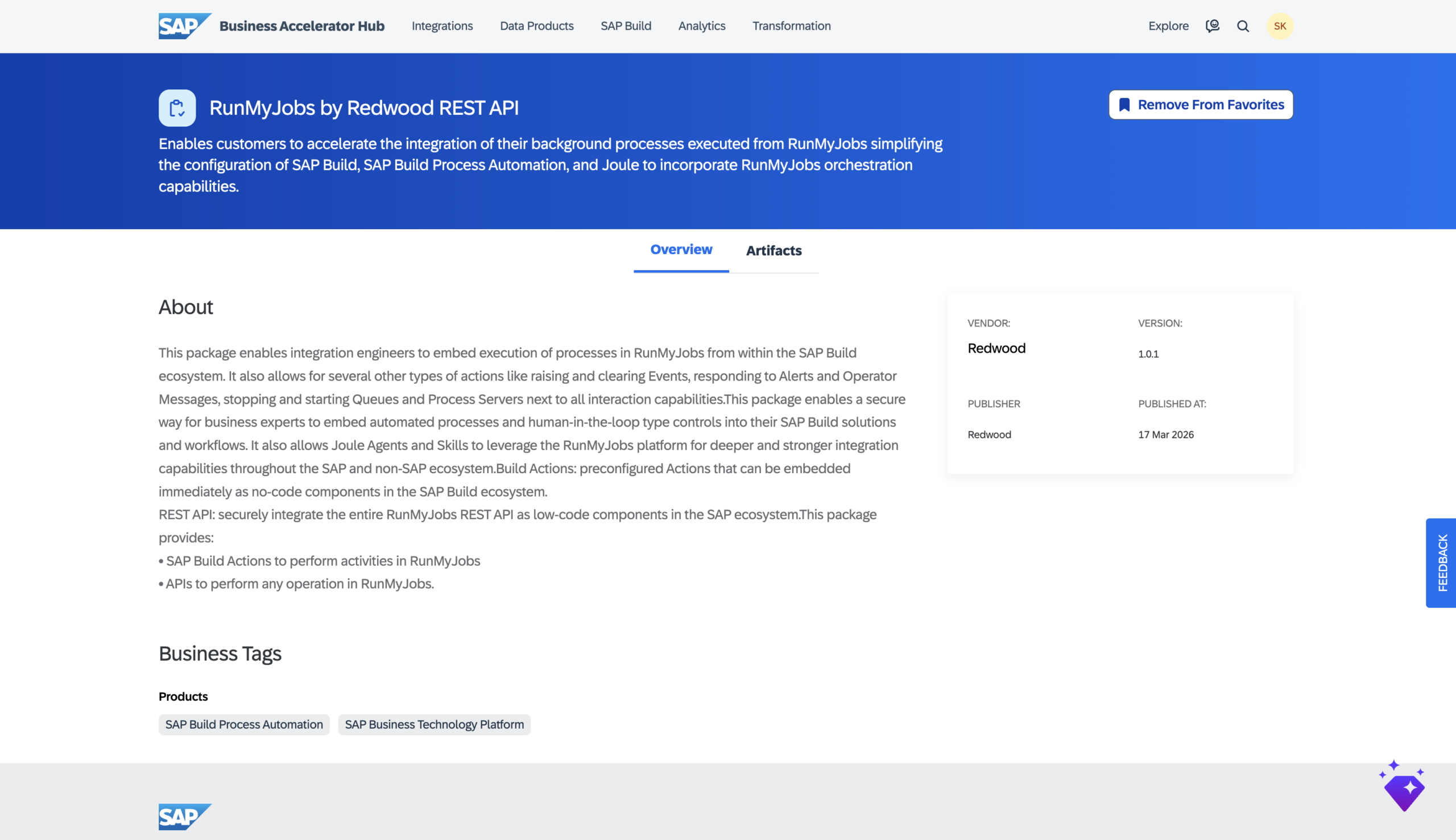
Two paths to governed agentic execution
Joule Agents can now connect to RunMyJobs in two ways: via Joule Skills using the pre-built SAP Build Actions in the SAP Business Accelerator Hub or through the Model Context Protocol (MCP) server.
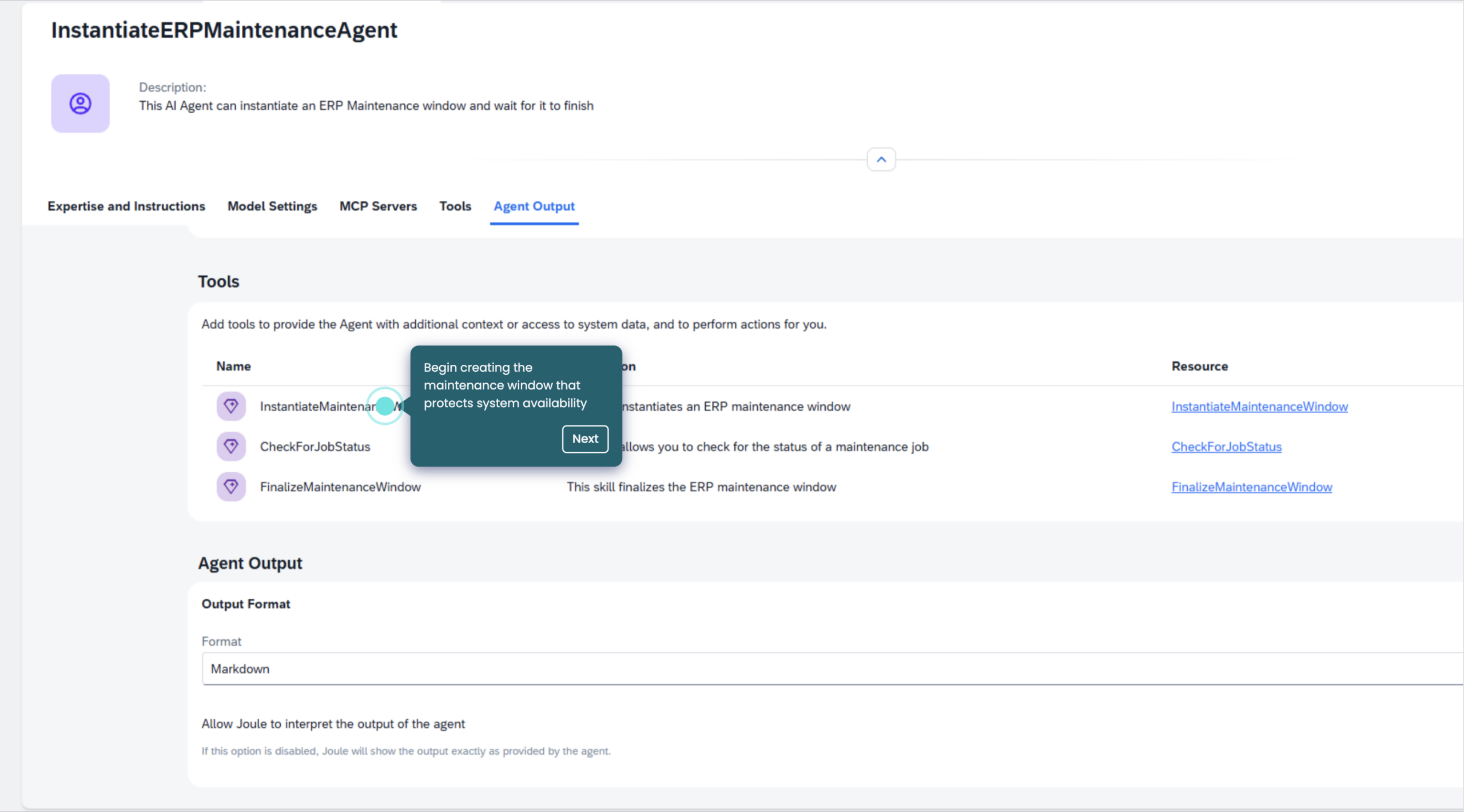
MCP is an open standard that gives AI systems a shared way to connect with external tools without custom integrations, and its addition to RunMyJobs means Joule Agents can trigger workflows, check job status and interact with your automation landscape through a protocol already adopted across every major AI platform.
See how MCP provides a standardized, governed connection path for agent developers who prefer not to build directly against the REST API.
Make your enterprise AI production-ready
Whenever AI is introduced into enterprise systems, the first concern is control. That’s why governance is foundational to this approach.
In RunMyJobs, every action is governed, logged and auditable. RBAC ensures that only authorized users can trigger specific workflows. So, a new interface doesn’t expand permissions. It simply provides a different way to interact with existing, approved automation.
Policies are enforced automatically. If an approval or validation is required, the workflow will not proceed without it. Every step executed by RunMyJobs is logged, including what was triggered, when it ran, who approved it and how it executed across systems. That audit trail is always available.
This matters not just in regulated environments, but because compliance, traceability and accountability are always critical. AI automation must operate within those controls.
Maintenance is a powerful starting point, but it’s only one example. The same conversational orchestration pattern applies across SAP-driven business processes and functions:
- Finance teams can trigger period close and reconciliation activities that depend on correct sequencing and validation
- Supply chain operations, where timing and cross-system coordination are critical, benefit from AI orchestration that reduces manual handoffs and delays
- Retail, utilities and HR teams can apply the same approach to order-to-cash, meter-to-cash and employee lifecycle workflows, respectively
Replace manual coordination with policy-driven execution, and help your teams spend less time managing handoffs and more time moving processes forward with confidence. Explore RunMyJobs in the SAP Business Accelerator Hub. To see how this applies to your SAP landscape,request a demo of RunMyJobs.
About The Author

Sven Kohlhaas
Sven Kohlhaas is Vice President – SAP Product Lead at Redwood Software. He is responsible for the global success and evolution of Redwood’s SAP-related product portfolio, helping organizations orchestrate complex business processes across their SAP and non-SAP systems. His vision is to drive operational excellence by empowering enterprises to maximize the value of their technology investments.
With almost 20 years of experience in the IT industry, most of which at SAP in high-impact product and engineering roles, Sven is a seasoned leader with unique subject-matter expertise. His background spans enterprise software, service orchestration and automation, SaaS and PaaS cloud platforms, GenAI and ERP systems. This deep technical foundation allows him to bridge the gap between legacy environments and next-generation cloud architectures.