- Glossary
- ERP Central Component (ECC)
ERP Central Component (ECC)
SAP ERP Central Component (ECC) is the functional successor to R/3 and serves as the integrated core of SAP’s legacy, on-premises ERP landscape. While it retains the proven three-tier architecture, ECC introduced the SAP NetWeaver platform, which allowed the system to transition into a more flexible, web-enabled environment.
ECC is:
- Database-agnostic: Unlike the modern S/4HANA, ECC is designed to run on various third-party relational databases (such as Oracle, SQL Server or DB2).
- Highly customizable: ECC is known for its high degree of ABAP-based extensibility, allowing organizations to build deep, custom logic.
- Modular: It manages integrated operations across core areas, including Financials (FI/CO), Logistics (SD, MM, PP) and Human Capital Management (HCM).
Note on support timeline: Mainstream maintenance for ECC 6.0 is scheduled to end in 2027, with an optional extended maintenance period available through 2030.
SAP R/3: The foundation of modern ERP
Introduced in 1992, SAP R/3 revolutionized enterprise software by moving away from centralized mainframe computing to a three-tier, client-server architecture. This structure, comprised of the database, application and presentation layers, established the blueprint for the next three decades of enterprise resource planning.
Historical significance and key innovations
R/3 was the first major ERP to allow businesses to run their software on various hardware providers and operating systems, moving away from vendor lock-in. It introduced a central software engine that abstracted the application logic from the underlying database, ensuring system stability across different environments.
R/3 enabled global organizations to distribute their workloads across multiple servers, providing the scalability needed for international expansion and pioneered the use of “logical units of work” to ensure that complex business processes across different departments remained synchronized and consistent.
While the architectural DNA of R/3 lives on in ECC, mainstream maintenance for original R/3 releases has concluded. These legacy systems are primarily found in specialized enterprise environments where they continue to support stable, long-standing business processes. Organizations still utilizing R/3-based architectures are generally focused on maintaining operational continuity while evaluating long-term migration paths to SAP Cloud ERP.
Optimizing SAP operations with RunMyJobs
RunMyJobs by Redwood provides a centralized, event-driven platform to orchestrate complex processes across the SAP landscape without requiring custom ABAP code or the installation of third-party agents.
- Unified orchestration: Coordinate complex workflows across ECC, S/4HANA, SAP Cloud ERP and non-SAP systems from a single, centralized engine.
- Event-driven agility: Replace rigid, time-based scheduling with real-time execution triggered by file arrivals, API calls, out-of-the-box connectors or database updates.
- Clean core strategy: Achieve end-to-end automation without requiring custom ABAP code or intrusive third-party agents inside your SAP environment.
- Governance and auditing: Maintain a centralized audit trail and real-time SLA tracking for all background processes to simplify compliance.
- Migration continuity: Maintain flawless process execution and data integrity during the transition from legacy ECC to modern S/4HANA and SAP Cloud ERP.
- Functional scalability: Smoothly transition your workload automation from ECC to SAP Cloud ERP with simultaneous support for both platforms and modules.
Keep mission-critical SAP processes stable
Related SAP topics
Explore more elements that shape evolving SAP environments.
NetWeaver
SAP NetWeaver is an application server platform that runs ABAP or Java. It uses systems and instances to manage how SAP applications are deployed and operated.
SAP Cloud ERP (S/4HANA)
SAP Cloud ERP is a cloud-based ERP system that uses AI, machine learning and analytics to automate business processes. It runs on the SAP HANA in-memory database for real-time data processing.
Supply Chain Management (SCM)
SAP Supply Chain Management (SCM) is a suite of solutions that leverages integrated data and embedded intelligence to align planning, execution and monitoring across sourcing, manufacturing, logistics and distribution.
RISE with SAP
RISE with SAP helps on-premises SAP ERP customers move to the cloud by combining software, infrastructure and services to modernize ERP using SAP Business Suite.
Related reading

SAP S/4HANA Architecture: A Complete Guide
Let’s delve into the realm of S/4HANA architecture, where cloud security and advanced efficiency converge. In this article, we’ll explore how S/4HANA fortifies your security posture, manages vulnerabilities and enhances cloud environments. Our focus? To help you understand this robust architecture, enabling you to make an informed decision.
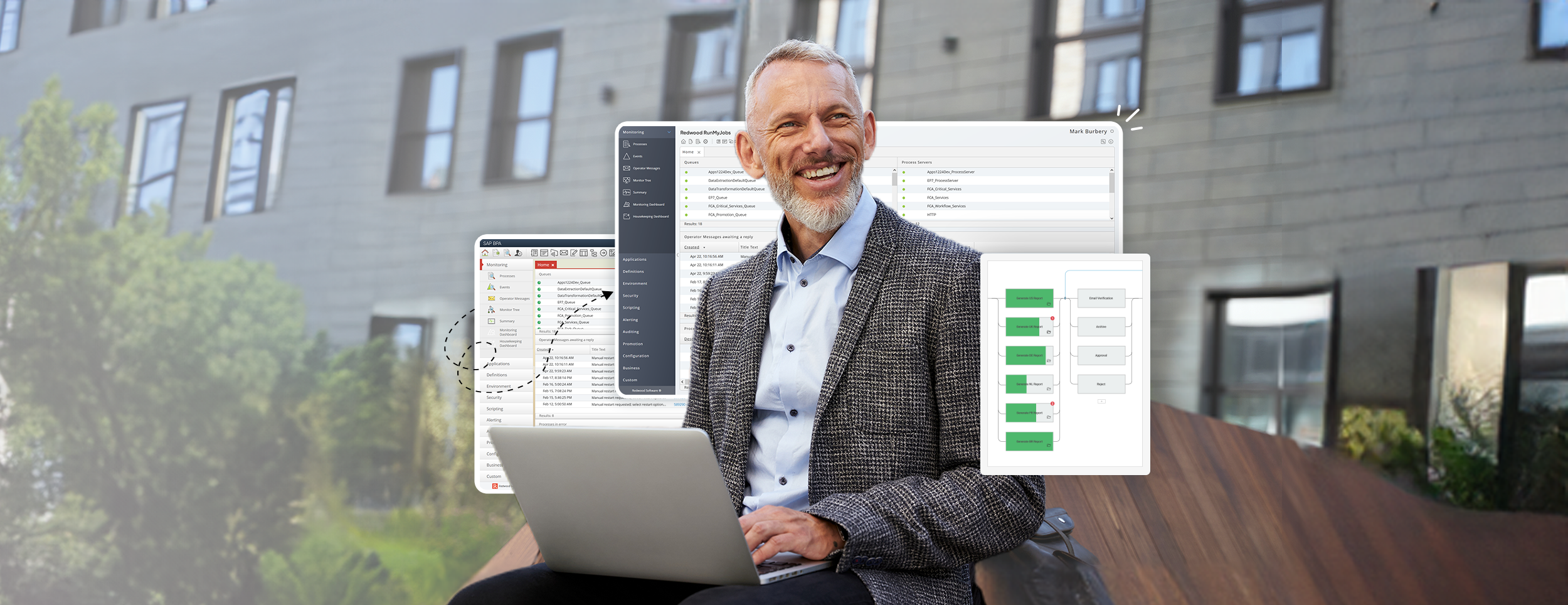
How to bring your SAP processes into the future with Redwood
Many enterprises that use SAP as their ERP are somewhere in the process of making the big move to S/4HANA. According to ASUG (America’s SAP User Group), 31% of SAP users have made the move, 13% have started and 42% are making plans to move. This migration is a complex undertaking for IT teams but drives and delivers more value for their organizations. As part of this strategic focus on S/4HANA, SAP will end support after December 2024 for many applications that rely on the NetWeaver Java stack — including SAP BPA by Redwood.
What is SAP Cloud: Navigating the future of business technology
With abundant business technology, SAP is a trusted beacon for companies seeking to innovate and streamline their operations. As a leading software giant, SAP has paved the way for enterprises to transition from traditional on-premise systems to agile, cloud-based solutions.

RISE above: How RunMyJobs mitigates — and eliminates — the many levels of enterprise risk
Discover how RunMyJobs has proven time and again that it takes unnecessary friction out of the migration process, and has grown and changed with SAP over three decades.
Check out these Integrations

SAP BusinessObjects
Produce more timely analytics and business intelligence in SAP Business Objects. Run and monitor processes to update reports and access log files.- Business Intelligence
-
SAP Business Warehouse (BW) / SAP BW/4HANA
Manage your SAP data storage and processing workflows. Run, intercept and monitor any Business Warehouse process chain, with full access to every step in the chain.- Data Management
-
SAP ERP / SAP ECC / SAP S/4HANA
Gain full automation for your SAP ERP system. Run, intercept and monitor any background program, apply variants, and orchestrate with events.- ERP

