Scheduling in modern SAP landscapes: SAP BTP Job Scheduling Service, Application Jobs and when to orchestrate
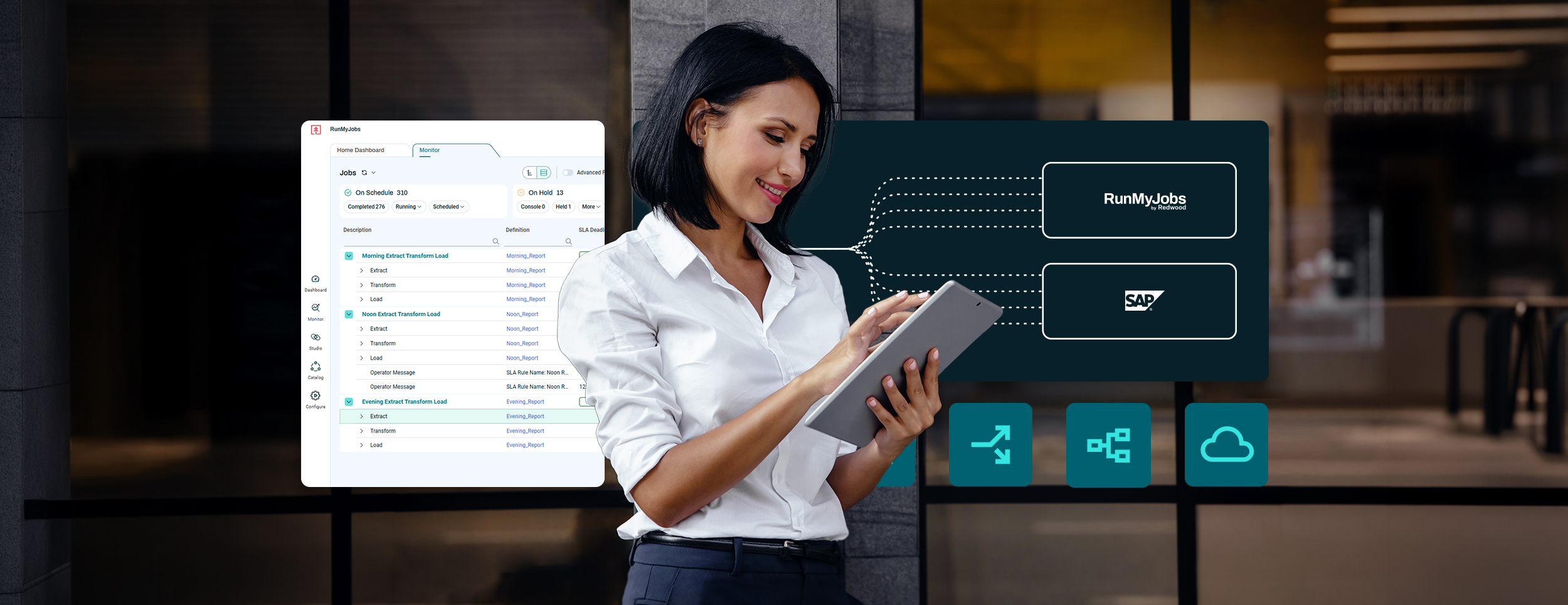
SAP landscapes have become considerably more complex than the tools most teams use to automate and optimize how heavy backend workloads run.
A decade ago, background job scheduling was a contained problem. SM36 and SM37 handled ERP processing, local schedulers covered the rest and the architecture those tools were built for was largely self-contained.
That architecture is gone for most enterprises. A single business process now routinely spans SAP S/4HANA, SAP Cloud ERP, SAP Business Technology Platform (BTP), SAP Business Data Cloud (BDC), SAP Analytics Cloud, Databricks, Snowflake, AWS … and the list goes on … before producing a result anyone can act on. Each platform executes reliably within its own boundary. Whether the process completes reliably across all of them is a problem local scheduling can’t solve.
To answer the question, “How does this job impact the entire business chain?” SAP architects must differentiate between simple task scheduling and true enterprise orchestration.
When local scheduling remains the right call
Native scheduling tools are legitimate architectural choices, not placeholders until something better comes along. For isolated, self-contained tasks with no upstream dependencies and no downstream impact — and where advanced or variable calendaring handles any scheduling complexity — they’re often exactly what the job requires.
Across a modern SAP estate, that means:
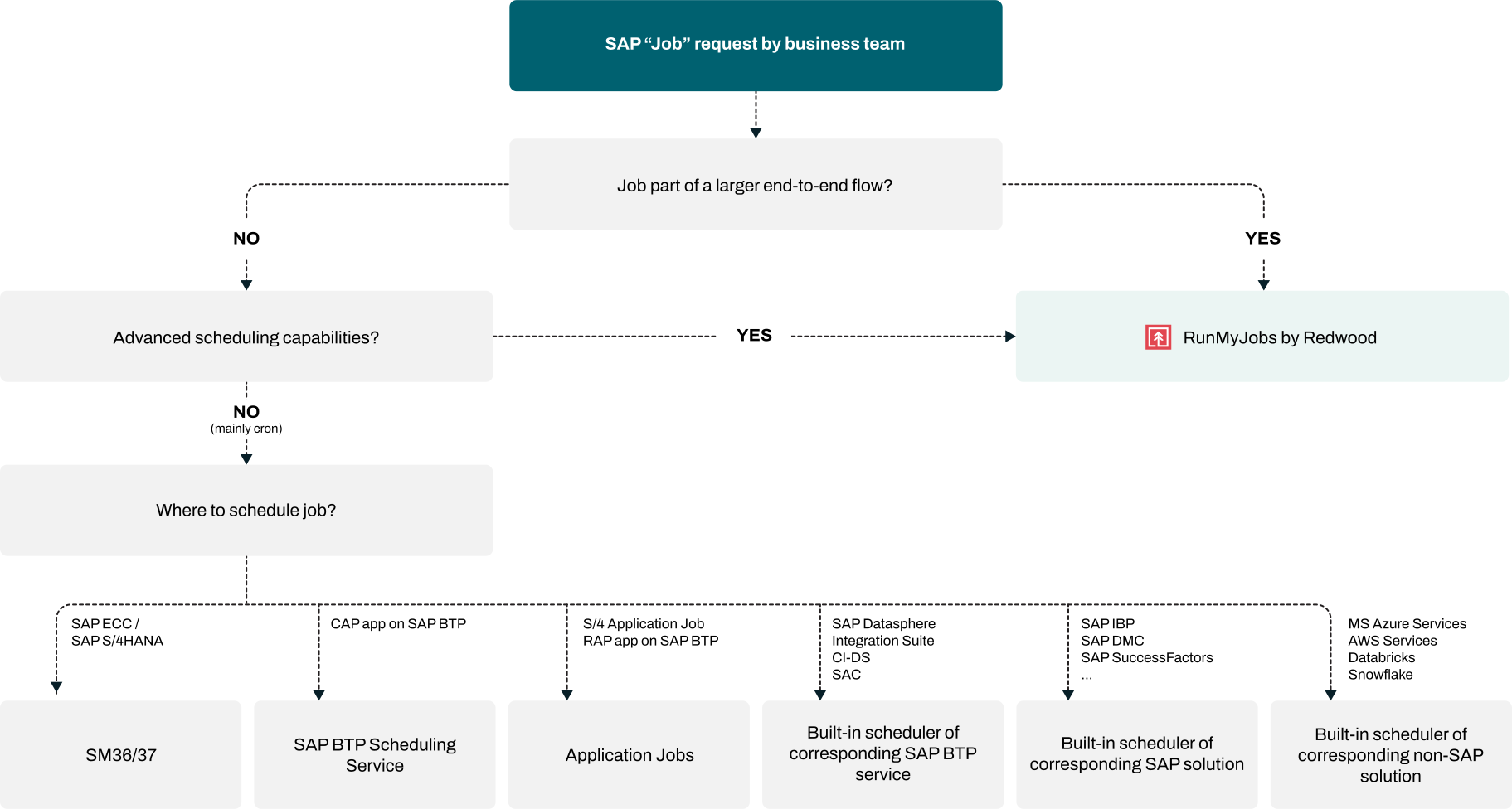
- SM36 and SM37 for standard background processing in SAP S/4HANA and SAP ECC: batch jobs, reports and ABAP programs that live entirely within a single ERP instance and don’t depend on external system state
- SAP BTP Job Scheduling Service for Cloud Application Programming (CAP) model applications running on SAP BTP Cloud Foundry: time-based or one-time job execution for CAP services that operate independently within the SAP BTP environment
- Application Jobs for RESTful ABAP Programming (RAP) model extensions on SAP S/4HANA: the metadata-driven, Fiori-integrated successor to SM36/SM37 for modern ABAP development, appropriate when the job scope stays within the SAP S/4HANA system boundary
- Native scheduling within SAP Integrated Business Planning (IBP), SAP SuccessFactors and SAP Digital Manufacturing: purpose-built schedulers for localized workloads inside those solutions, where cross-system coordination isn’t required
- Built-in schedulers in Snowflake and Databricks for internal scripts and transformations that begin and end within those platforms
The common thread is isolation. Each of these tools executes reliably when the task it governs doesn’t depend on the state of another system and doesn’t need to trigger work in one.
Trigger points: When traditional scheduling becomes operational risk
Three conditions reliably signal that native scheduling is no longer sufficient.
- The job becomes a link in a cross-system chain. As soon as a task has an upstream dependency outside its own platform or triggers a downstream action in another system, local schedulers start operating on assumptions. For a material requirements planning (MRP) run that depends on an external warehouse feed completing first, a Datasphere refresh that needs to finish before SAP Analytics Cloud models publish or a CAP service on SAP BTP that should only execute after an upstream SAP S/4HANA job confirms success, native schedulers in each of those systems can only confirm that their own job ran. None of them can verify the state of the system that the next step depends on.
- You need resource-aware, resilient execution. High-concurrency workloads like SAP Datasphere task chains, Databricks pipeline runs and overnight batch sequences across multiple platforms require load balancing, automated retry logic and intelligent error handling. Without a coordination layer, a single failure can cascade across dependent processes before anyone is notified.
- Your roadmap involves eliminating operational blind spots. RISE with SAP and clean core transformations distribute process logic across SAP BTP services, cloud extensions and non-SAP platforms. That distribution improves architectural flexibility and creates a new operational problem: no single view of what’s running, what’s waiting and what failed across the landscape. Each platform reports on itself, but nothing reports on the process.
Governed execution in practice
RunMyJobs by Redwood is designed to take over at the boundary where native scheduling capabilities end. Rather than replacing SM36/SM37, Application Jobs or the SAP BTP Job Scheduling Service, it coordinates them — along with every other system in the landscape — into governed, end-to-end process flows. Workflows execute based on verified event completion and real-time system state, where a downstream process starts because the upstream transformation succeeded, not because a timer reached a predetermined hour.
The difference a dependency makes
| Scheduling | Orchestration |
| Runs isolated tasks | Coordinates end-to-end business processes |
| Time-based execution | Event-driven, latency-aware execution |
| Local system visibility | Cross-platform visibility |
| Static, assumed dependencies | Dynamic, verified dependencies |
| Reactive troubleshooting | Centralized operational intelligence |
RunMyJobs’ out-of-the-box connectors span SAP S/4HANA, SAP BTP, SAP BDC, SAP Datasphere, SAP Analytics Cloud, SAP Cloud ALM, SAP Build Process Automation, Databricks, Snowflake, AWS and ServiceNow, making cross-platform dependency management possible without custom code.
For RISE with SAP and SAP Cloud ERP environments, RunMyJobs connects through its Secure Gateway and agentless architecture, consistent with how SAP Cloud Connector operates. It’s the only workload automation and orchestration platform included in the RISE with SAP reference architecture. With no agents inside the ERP and no custom ABAP, RunMyJobs supports clean core principles from the start.
Coverage extends across the full range of modern SAP development models: Application Jobs, RAP-based extensions, CAP services on SAP BTP, SAP Datasphere pipelines, SAP Integration Suite workflows and AI-driven scenarios involving Joule.
Job requirements decision tree
Build the control layer before you need it
Most teams introduce enterprise orchestration after complexity has already compounded — after the first SLA breach that took half a day to trace, the planning run that produced results on incomplete data or the migration that left three separate scheduling tools running in parallel with no consolidated view across them.
Getting ahead of that inflection point is considerably easier than resolving it afterward. Teams that introduce RunMyJobs early in their RISE with SAP journey retire legacy schedulers, establish governed dependency management and build a control layer that scales with the architecture from the start.
SAP’s native tools still do what they were designed to do, while orchestration governs what happens between them.
Get a demo of RunMyJobs, and explore its full range of SAP connectors to see how enterprise orchestration extends across SAP S/4HANA, SAP BTP, SAP BDC and your broader cloud landscape.
About The Author

Sven Kohlhaas
Sven Kohlhaas is Vice President – SAP Product Lead at Redwood Software. He is responsible for the global success and evolution of Redwood’s SAP-related product portfolio, helping organizations orchestrate complex business processes across their SAP and non-SAP systems. His vision is to drive operational excellence by empowering enterprises to maximize the value of their technology investments.
With almost 20 years of experience in the IT industry, most of which at SAP in high-impact product and engineering roles, Sven is a seasoned leader with unique subject-matter expertise. His background spans enterprise software, service orchestration and automation, SaaS and PaaS cloud platforms, GenAI and ERP systems. This deep technical foundation allows him to bridge the gap between legacy environments and next-generation cloud architectures.