Agentic orchestration in RunMyJobs: What it takes to make enterprise AI operational
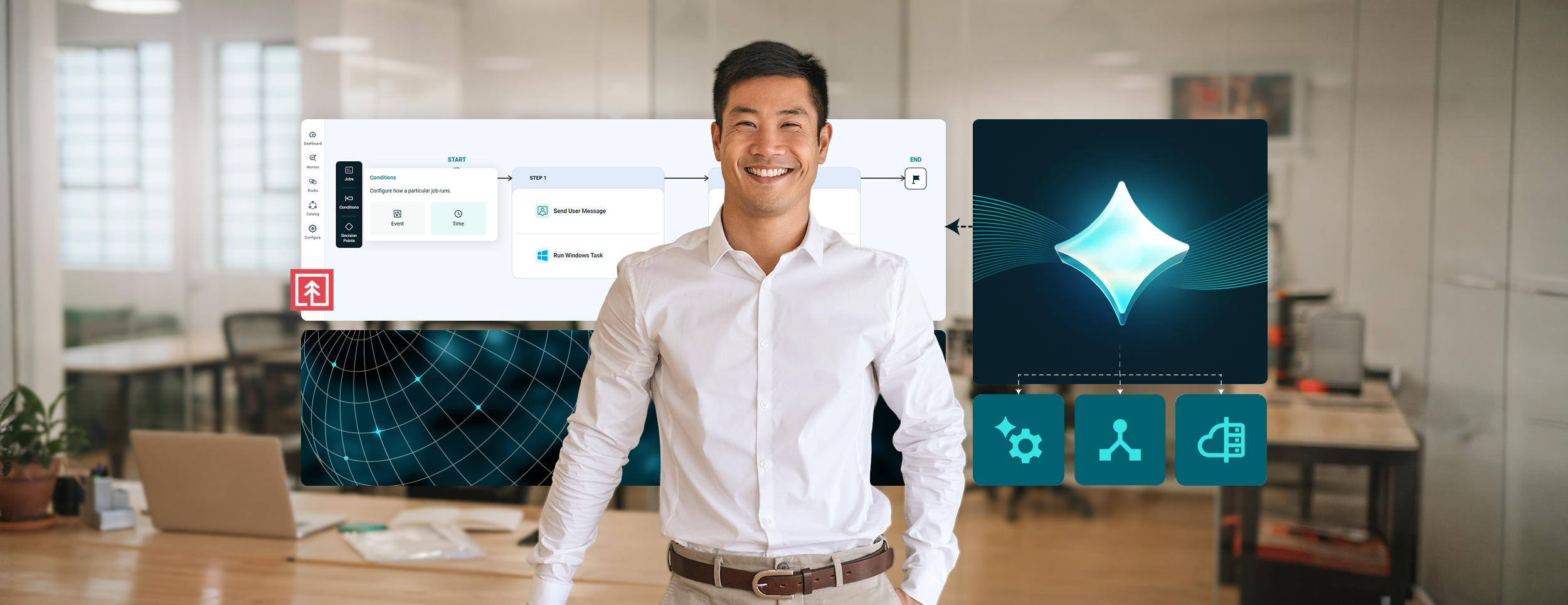
Plenty of vendors are bolting a chatbot onto an automation platform and calling it agentic. At Redwood Software, we think that’s backwards. Governance, reliability and scale aren’t qualifiers you add to a product. They are the product.
Every agentic action in RunMyJobs by Redwood, from a single job step to a complex multi-agent workflow, is traceable, auditable and compliant. Deterministic guardrails apply hard-coded logic constraints to probabilistic AI, preventing rogue agent behavior before it reaches your systems of record. Your existing automation doesn’t get replaced — it becomes AI-ready, so you build on what already works.
Agentic orchestration, defined
Agentic orchestration connects AI reasoning to real-world execution — safely, reliably and at enterprise scale. The destination is autonomous execution, where systems operate independently, make dynamic decisions and self-correct in real time, overseen by people and governed through orchestration.
That doesn’t mean an enterprise without people. It means humans set intent, provide context and maintain high-level oversight while intelligent systems handle routine work and complex coordination underneath. The orchestration layer is what makes that division of labor trustworthy rather than aspirational.
Start building autonomous workloads now
We built RunMyJobs’ AI capabilities the way we did because the pressure on enterprise automation teams is real and coming from multiple directions at once.
- Shadow AI is already inside your business. Departmental agents are spreading without central oversight, exposing sensitive data and credentials to third-party AI while critical business logic gets trapped inside individual chat histories. 82% of organizations discovered shadow AI agents in the past year.
- Agentic conflict is coming. Agents optimized for different outcomes will collide over goals, shared resources and policies, the same way human departments do, except faster and at machine scale. Gartner projects at least 15% of day-to-day work decisions will be made autonomously by 2028. Somebody has to referee that, and it won’t be a spreadsheet.
- Your automation was built for absolute certainty. AI agents reason probabilistically. Those are incompatible worlds, and rebuilding decades of critical business logic to force them together is neither feasible nor safe. One agentic hallucination can poison a data pipeline or exploit permissions that were designed for rigid scripts, not goal-seeking software.
- The environment is shifting. Gartner also predicts that 33% of enterprise software applications will include agentic AI by 2028. When a third of the software landscape assumes agents are present, platforms that can’t govern them become a liability.
The path forward is incremental
You don’t have to reach full autonomy overnight. Like any automation maturity journey, the path to agentic orchestration is progressive. You start by augmenting your people with AI-powered productivity tools. Then, you make your existing business processes AI-ready so agents can reach the systems that matter. Eventually, you orchestrate autonomous agents natively inside the workflows your enterprise already depends on.
That progression only works if the platform underneath is designed to support each stage without requiring you to rip out what you did in the last one. The AI capabilities in RunMyJobs map to three building blocks: agentic productivity, agentic business processes and agentic enterprise, each solving distinct problems and delivering value independently. Every step forward is governed and reversible. Here’s what each one looks like in practice.
Building block 1: Agentic productivity
Start with making people more productive, building and managing automation at scale.
The Redwood RangerAI Product Assistant and Automation Co-pilot embeds an intelligent expert inside the platform, right next to every operator. Instead of digging through documentation or waiting on the one senior person who knows everything, your team asks a question and gets a grounded, plain-language answer. The Co-pilot:
- Generates job scripts from natural language
- Operates the platform through conversational commands
- Produces documentation in a click
Junior engineers start resolving issues that previously sat in a senior architect’s queue.
Workflow Builder tackles a bottleneck most automation teams have simply accepted as life: the specialist intake queue. Every new workflow goes through a developer, usually via a ticket, and some enterprises process 30 to 50 of those a week. With Workflow Builder, a process owner describes a new data reconciliation workflow in plain English or uploads an SOP, and an intent agent:
- Matches the request to the actual jobs, connectors and schedulers already in the environment
- Builds the chain and resolves parameters
- Flags anything it can’t resolve for human input
- Creates nothing until a human explicitly approves
The specialist’s role shifts from building to reviewing.
Building block 2: Agentic business processes
This is where you make your existing business logic AI-ready without rewrites, custom APIs or architectural overhaul.
The RunMyJobs Model Context Protocol (MCP) server gives your AI reasoning tools governed access to the systems that actually run the business. Over 50 tools across nine global AWS regions, with OAuth 2.0 authentication and per-request credential isolation.
Your workflows become the agent’s toolbox.
Instead of giving an agent raw credentials to your ERP, you give it a workflow that already encodes the right steps, permissions and error handling. The agent gets a trusted tool. Your systems get a hard boundary and full audit traceability. For SAP-centric customers, the MCP server is validated with SAP’s Joule, so your SAP AI assistant can invoke RunMyJobs operations natively.
In practice, this opens up entirely new operating models:
- An operations engineer uses Microsoft Copilot or Slack to submit jobs, restart failed steps and raise events through natural language without opening the RunMyJobs UI
- A finance team’s AI assistant, scoped to their partition, triggers a reforecast workflow when demand signals change, monitors status and notifies the team on completion — without IT involvement
- A developer uses Claude Code to trigger a data refresh in a production environment, then RunMyJobs verifies all dependencies and prerequisites are met, giving Claude a trusted way to execute in critical environments.
The Operations Agent tackles one of the most persistent costs in enterprise automation: overnight incident triage. It changes what an alert means:
- Proactively detects failures, SLA deviations, silent completions and cascade outages
- Delivers enriched alerts with job history, blast radius, SLA countdown and suggested next actions
- Groups dozens of alerts from a single root cause into one incident
When a critical batch job fails at 3 AM, the agent identifies the twelve downstream jobs at risk, calculates the SLA countdown and delivers a single contextualized notification — before the engineer touches the keyboard. The destination is fully autonomous tier-one and tier-two remediation.
Building block 3: Agentic enterprise
Agent Studio gives you the lowest-friction path to embedding agents inside the workflows you already run.
Write agent skills, connect MCP servers as tools, choose your preferred LLM and drop the agent in as a step under the same governance and observability model as everything else. Your deterministic processes stay unchanged. The agent adds a judgment layer for exception handling, risk scoring or compliance narrative drafting, and a human stays in the loop on every consequential call.
- A reconciliation agent investigates mismatches, resolves known patterns and escalates only genuinely novel cases
- An approval agent risk-scores incoming requests, auto-clears low-risk items with an audit trail and routes the rest to a human
- A compliance agent drafts the narrative auditors need, summarizing what changed each period for human review
Consider a data validation job that encounters an anomalous record set matching no existing exception rule. An Agent Studio step invokes an LLM to classify the anomaly, decides whether to escalate or auto-resolve and writes the outcome to an output parameter, all within the same job chain and under the same partition governance.
As you scale beyond individual agents, agentic workflows coordinate fleets of specialized agents toward shared goals with managed state, shared context and centralized conflict resolution. And the agentic library eliminates the cold-start problem by transforming your existing jobs, workflows and enterprise connectors into trusted tools and pre-built skills. Your agents show up already understanding your business.
Start where you are
Redwood brings 30 years of enterprise experience and the trust of more than 50% of the Fortune 50. RunMyJobs is the only SAP Endorsed App for workload automation and orchestration and the only Service Orchestration and Automation Platform (SOAP) in the RISE with SAP reference architecture. That trusted foundation is what makes governed autonomy possible at enterprise scale.
You don’t need to overhaul everything at once. Augment your operators. Make your existing logic AI-ready. Embed one agent inside one workflow you already run. Each move builds trust, extends autonomy and delivers something measurable, and you can pause or reverse at any point.
Explore the AI and agentic capabilities in RunMyJobs and find your starting point.
About The Author

Giampiero “Gp” De Ciantis
Giampiero “Gp” De Ciantis is a Director of Product Management at Redwood Software, where he leads product strategy and enablement for RunMyJobs’ agentic AI initiatives. Gp drives the roadmap and go-to-market for agentic orchestration, bringing together new technologies, platform architecture and customer requirements to make autonomous agents practical for enterprise automation.