2026 Gartner® Critical Capabilities for SOAP: Redwood Software ranks #1 in 4 Use Cases, tied for #1 in 5th Use Case
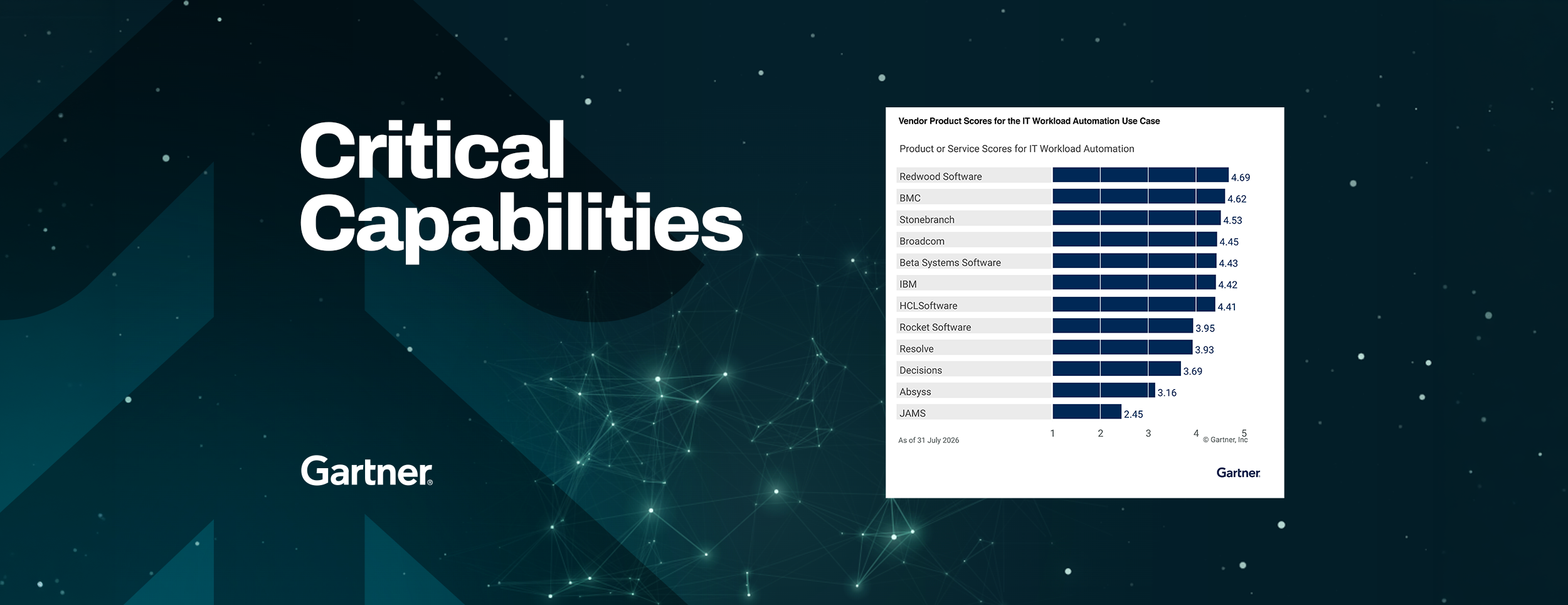
| A message from Kevin Greene, Redwood Software CEO Earlier this month, we announced that Gartner® named Redwood Software a Leader, positioned furthest in Completeness of Vision for the third year in a row, in the 2026 Magic Quadrant™ for Service Orchestration and Automation Platforms (SOAP) report. I’m excited to share that Redwood was also ranked #1 in four out of five Use Cases and tied for #1 in one Use Case in the 2026 Gartner Critical Capabilities for SOAP report. I believe these #1 rankings are an ongoing, powerful validation of Redwood’s strategy and investments. In our opinion, this recognition from Gartner analysts reflects our singular focus on building product capabilities that deliver transformative results for our customers and accelerating their path to the autonomous enterprise by embedding AI into the governance model they already trust. |
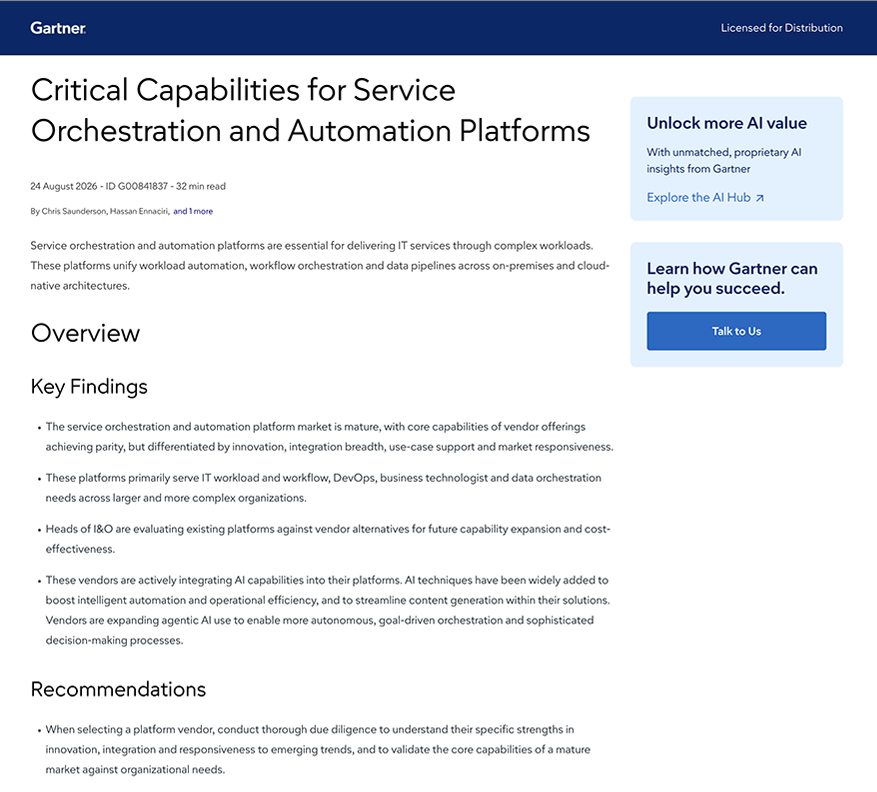
Redwood’s recognition in the Gartner Critical Capabilities report
“As an essential companion to the Gartner Magic Quadrant, this methodology provides deeper insight into providers’ product and service offerings by extending the Magic Quadrant analysis. Use this research to further investigate product and service ratings based on key capabilities set to important, differentiating use cases.”*
The Critical Capabilities research includes rankings for: IT Workload Automation Use Case, IT Workflow Orchestration Use Case, Data Orchestration Use Case, Business Technologists Use Case and DevOps Automation Use Case.
Redwood ranked first in four out of five Use Cases and tied for first in one out of five Use Cases.
IT workload automation
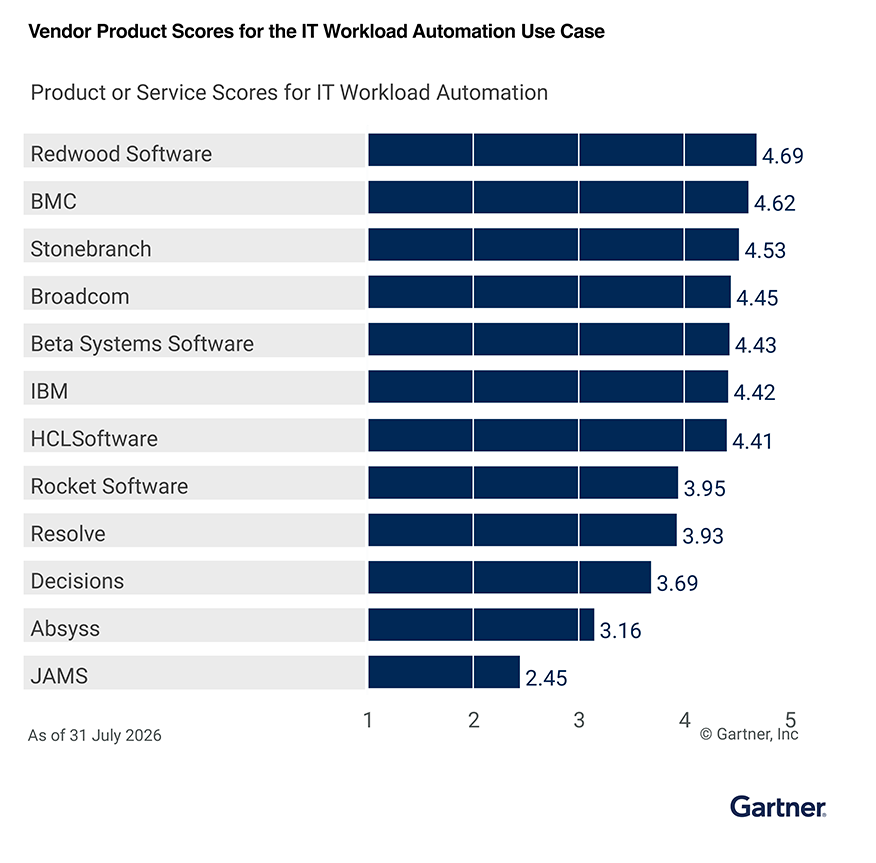
Gartner defines IT workload automation as follows: “Automating the planning, execution, management and reporting of complex IT workloads across enterprise systems.”
We believe this ranking reflects the broad power of our composable automation platform to integrate and manage diverse technologies across the hybrid enterprise. Available as native SaaS for the lowest total cost of ownership (TCO) or self-hosted on-premises or in the cloud, Redwood’s flagship workload automation and orchestration platform delivers the deployment flexibility enterprise customers require.
RunMyJobs by Redwood brings an easy-to-use, modern, AI-powered experience to every stage of the automation lifecycle, from natural-language troubleshooting and workflow creation to intelligent proactive monitoring. Extensive auditing capabilities, an expansive connector catalog and comprehensive APIs ensure unmatched reliability and business continuity for even the most complex workloads.
This is further enhanced by advanced monitoring and observability capabilities: a unified view of process health and performance with built-in AI and an easy-to-use, drag-and-drop experience that lets teams build their own dashboards and focus on continuous improvement and innovation. Teams can view their entire orchestration ecosystem, from performance to configuration, to diagnose root causes, optimize workflows and track compliance.
IT workflow orchestration
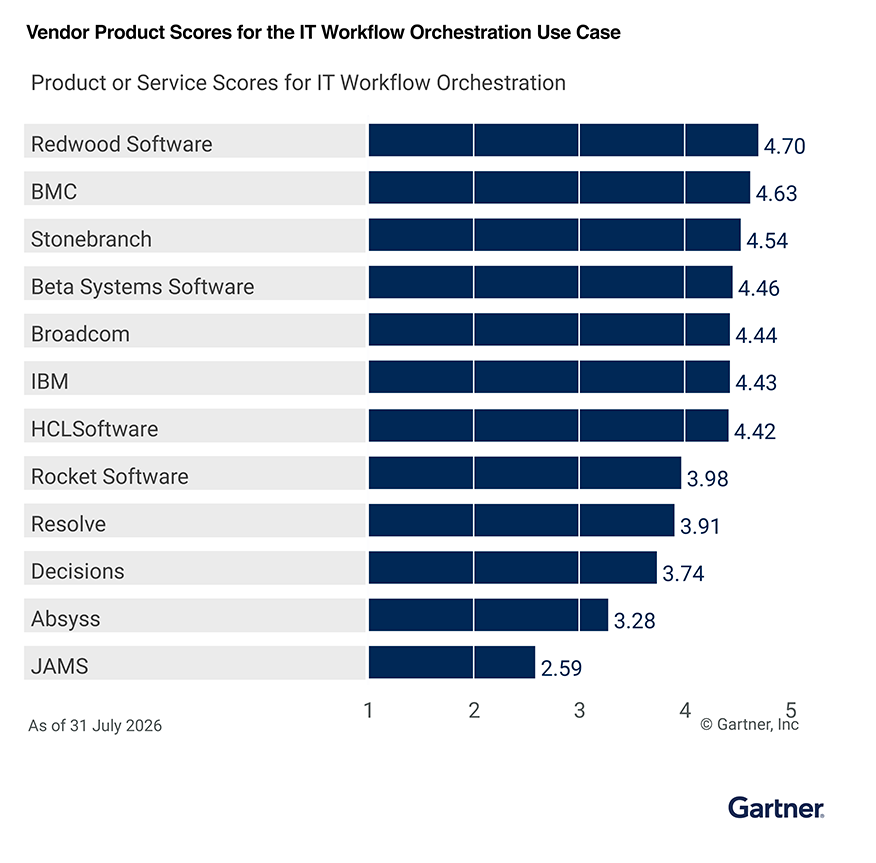
Gartner defines IT workflow orchestration as follows: “Defining, executing and reporting on IT workflows across diverse IT and enterprise systems.”
We feel this score highlights our strength in orchestrating intricate dependencies across disparate systems. Redwood’s extensive library of pre-built certified connectors eliminates custom scripting, enabling users to visually build and manage complex, end-to-end workflows while centralizing control and visibility.
No large enterprise runs on a single platform — business services have dependencies that span SAP, AWS, SaaS and on-premises systems — and RunMyJobs governs and connects the entire hybrid estate from one platform, with native connectivity that replaces custom scripts and middleware. That unified control extends across every dependency, from job execution to SLA tracking, so teams get one consistent view instead of stitching together several.
The result: seamless service delivery and optimal operational control.
Data orchestration
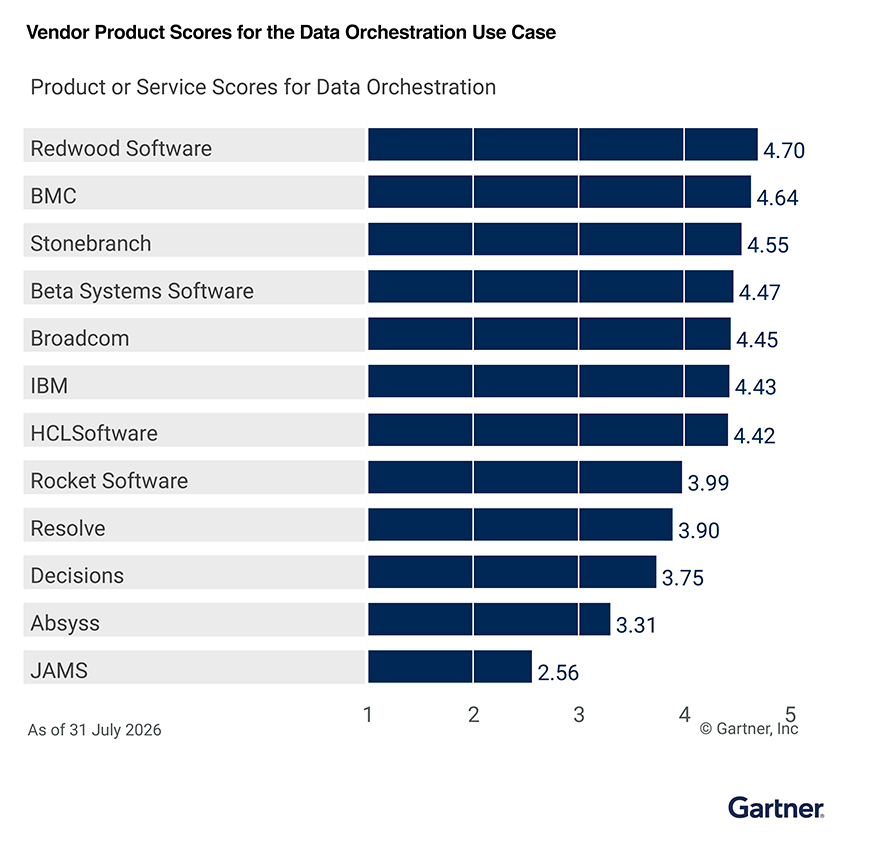
Gartner defines data orchestration as follows: “Planning, executing, managing and reporting on data-focused workloads like ETL/ELT and reporting for data use cases.”
We believe our #1 score in this Use Case demonstrates the power of Redwood solutions to unify and manage complex data pipelines from ingestion to reporting, across SAP, AWS, cloud and on-premises systems alike. Redwood provides the flexibility to connect to any data source and application, giving DataOps teams the end-to-end visibility required to ensure effective data management and that key information is timely, accurate and readily available for the business.
That same rigor is what makes AI initiatives possible: AI is only as good as the data behind it, and reliable, well-orchestrated data pipelines are the foundation RunMyJobs is built to deliver.
Business technologists
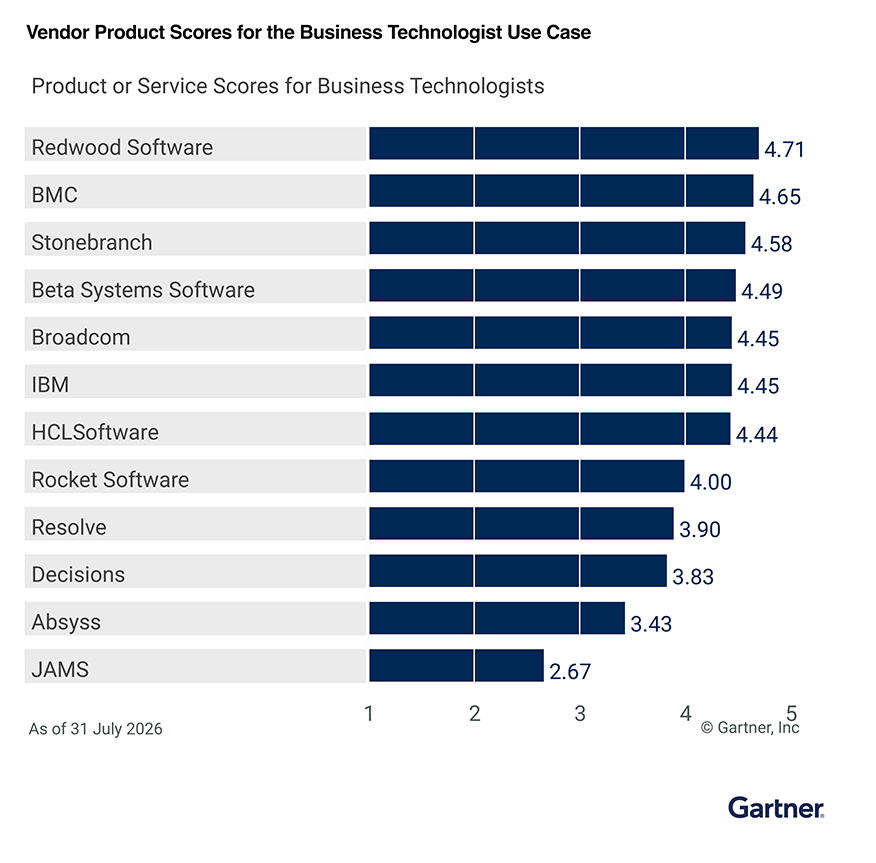
Gartner defines business technologists as follows: “Enabling end-users to develop and execute curated automations under IT governance.”
We feel this score represents Redwood’s commitment to empowering business teams and subject-matter experts to create and manage their own automation solutions safely. Our customizable and intuitive user interface includes a visual, low-code automation design studio, which enables teams to abstract away complexity, while centralized IT governance ensures every user-built automation is secure and reliable.
Redwood RangerAI extends this further, giving non-technical users the tools to work confidently inside RunMyJobs without specialized training. The Workflow Builder uses AI-powered reasoning to turn a plain-English description or an SOP into a complete, reviewable workflow draft, taking teams from policy to production in minutes rather than routing every request through a specialist queue.
Business users can also now give any compatible AI agents — Microsoft Copilot, SAP’s Joule, Claude Code and more — governed, zero-code access to every workload operation through our production-ready MCP server, closing the gap between AI that can reason about the estate and the operational systems that run it. Business teams can trigger, monitor and respond to the workflows they own directly from the AI assistant of their choice, without ever needing direct access to the platform UI, all while staying inside the same partition and governance boundaries IT relies on.
DevOps automation
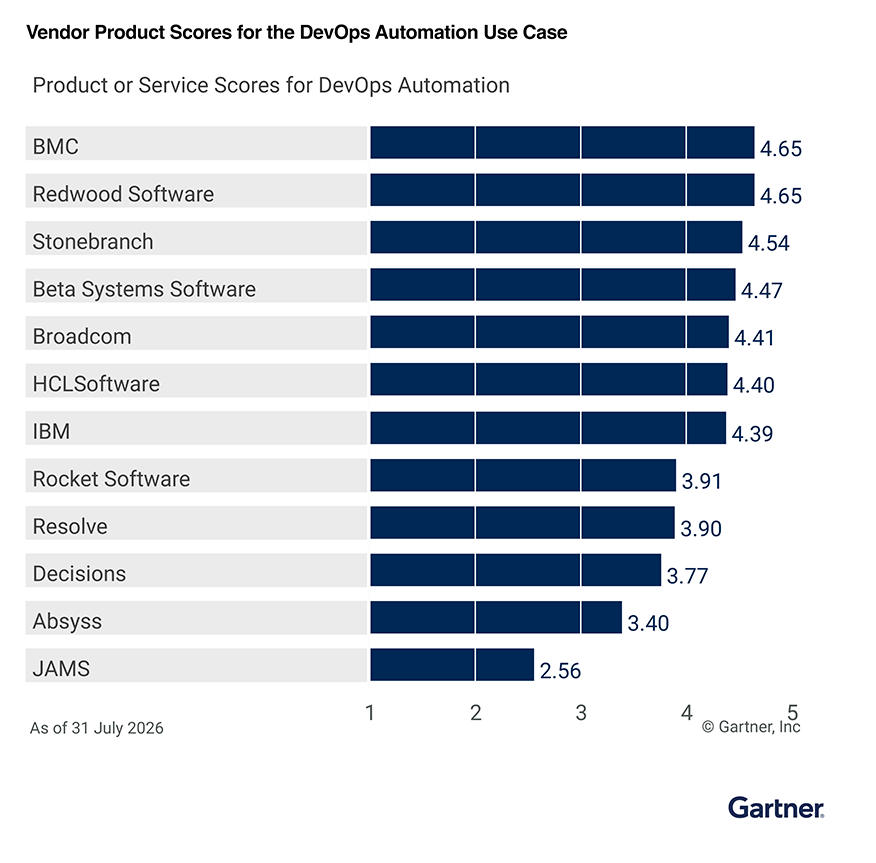
Gartner defines DevOps automation as follows: “Developing and testing automation workflows to support product delivery via DevOps tools and practices.”
We believe this recognition highlights how seamlessly RunMyJobs integrates into the software development lifecycle (SDLC). DevOps teams can define, version, test and promote automation workflows just like any other application code, accelerating release cycles and improving collaboration between development and operations.
Our production-ready MCP server extends that same discipline to AI: developers can promote jobs, submit test runs and check environment health directly from Claude Code, Microsoft Copilot or any MCP-compatible tool, without maintaining custom integrations that break every time the AI tooling landscape shifts.
Boost your orchestration strategy
Get your copy of the full analyst report here to empower your decision-making process. Demo our suite of orchestration, file transfer and finance automation solutions to start unleashing the human potential in your organization.
*Source: Gartner Critical Capabilities Methodology
Gartner, Inc. Magic Quadrant for Service Orchestration and Automation Platforms. Hassan Ennaciri, Daniel Betts, etl. 5 August 2026.
Gartner, Inc. Critical Capabilities for Service Orchestration and Automation Platforms. Chris Saunderson, Hassan Ennaciri, Daniel Betts, etl. 24 Aug 2026.
GARTNER is a registered trademark and service mark of Gartner, Inc. and/or its affiliates in the U.S. and internationally, and MAGIC QUADRANT is a registered trademark of Gartner, Inc. and/or its affiliates and are used herein with permission. All rights reserved.
Gartner does not endorse any vendor, product or service depicted in its research publications, and does not advise technology users to select only those vendors with the highest ratings or other designation. Gartner research publications consist of the opinions of Gartner’s research organization and should not be construed as statements of fact. Gartner disclaims all warranties, expressed or implied, with respect to this research, including any warranties of merchantability or fitness for a particular purpose.
These graphics were published by Gartner, Inc. as part of a larger research document and should be evaluated in the context of the entire document. The Gartner document is available upon request from https://www.redwood.com/resource/gartner-critical-capabilities-soaps/.
About The Author

Kevin Greene
Kevin Greene brings more than 25 years of enterprise software leadership experience as an operator, board member, investor, and investment banker working with breakthrough technology companies. Prior to joining Redwood, Kevin was the CEO of Logi Analytics, a private equity-backed enterprise software company and leader in embedded analytics, which successfully exited to insightsoftware in April of 2021. Kevin has also served as a Partner at Valhalla Partners, a $440 million venture capital firm in Virginia. He was also a principal at Flagship Ventures, an early-stage venture capital firm in Massachusetts. Prior to Kevin’s venture career, he held both director-level and product marketing roles at IBM. Kevin started his career at Goldman Sachs in its New York and Hong Kong offices.
Kevin has an MBA from the Harvard Business School. He earned a Bachelor of Science in Finance and Marketing from the University of Virginia’s McIntire School of Commerce where he also captained the Virginia varsity swimming team.