
Blog
Transform your operations with predictive SLA monitoring
See how predictive SLA monitoring spots at-risk milestones early, so you never miss a deadline.
Transform reactive incident management into predictive response. RunMyJobs by Redwood delivers AI-driven early warnings and automated remediation for mission-critical processes across cloud, ERP and on-premises systems.

Identify and react to risks before they impact operations across ERP, cloud, data and legacy platforms, with automated recovery and self-healing workflows.

Identify risks before SLA windows close with real-time dependency visibility and configurable alert thresholds.

Trigger remediation actions automatically when your SLAs are at risk.

Monitor workflows across on-premises, AWS, Azure and Google Cloud, ERP, data platforms and Airflow from a single control plane.

Track workflows, SLAs and system health in real time with alerts routed to appropriate teams for faster resolution.

Maintain compliance with audit trails showing what ran, when it ran and who changed workflow execution.

Connect applications and deploy orchestrations in seconds without operational overheads or agent maintenance.
Without end-to-end orchestration visibility, war rooms, bridge calls and manual recovery become the default response to every failure. Teams spend more time firefighting than improving the operating model, and MTTR becomes the metric everyone notices when business process SLA deadlines are missed.

Business users find data failures before IT does because teams lack business-level SLA alerts. The pipeline ran, but data arrived late, incomplete or untrusted by the business when deadlines passed.
Business processes inherently have a complex web of cross-system dependencies. Without a codified way to manage those, every failure triggers expensive coordination efforts.
The job showed green, but the data arrived two hours late. That still counts as an SLA failure. Teams need to manage data delivery against business deadlines, not just completion status.
Audit readiness becomes difficult when execution evidence is spread across fragmented tools. Collecting proof of what ran, when it ran and what changed takes days of manual effort.
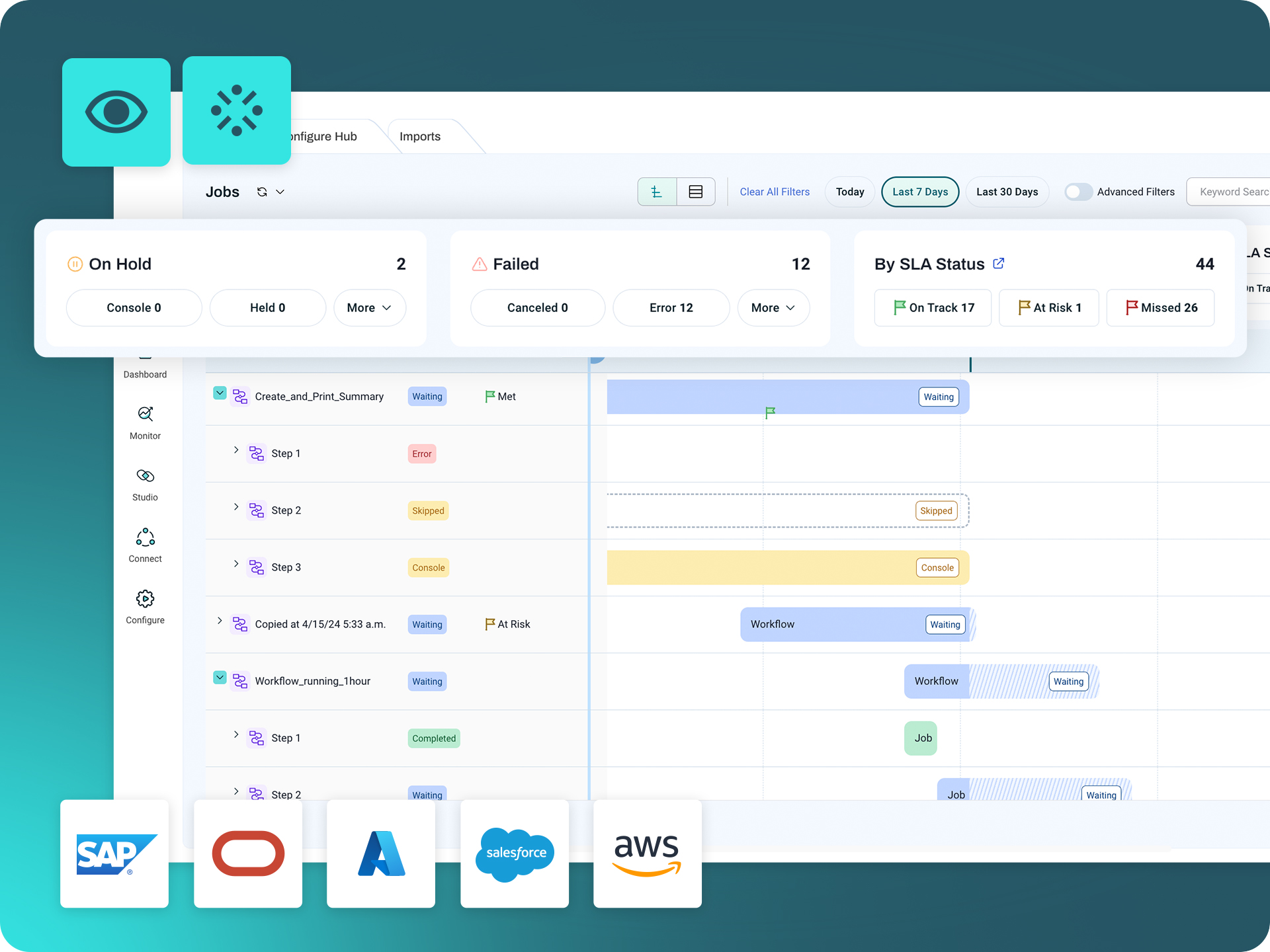
Run workflows within complex production services with SLA monitoring, dependency visibility, reusable templates, audit history and automated remediation across business-critical processes. Turn data delivery into a governed business service with measurable SLA attainment.
Give your teams the ability to orchestrate complex, cross-platform workflows through visual design, connector catalog, event/time-based triggers and real-time operational visibility with SLA-based control across hybrid environments.

Eliminate mean time to recovery by acting before workflows miss business deadlines through AI-driven predictive monitoring.
Eliminate manual recovery and reduce business disruption with automated remediation that triggers before SLA misses.

Build trust with business stakeholders by consistently delivering reliable data that meets committed SLA timeframes.

Speed issue resolution with cross-system dependency mapping that shows exactly where workflow delays originate.
Streamline regulatory compliance with automated execution records built into every workflow and process step.

Maintain security and governance with role-based controls that ensure only authorized users can modify business-critical processes.
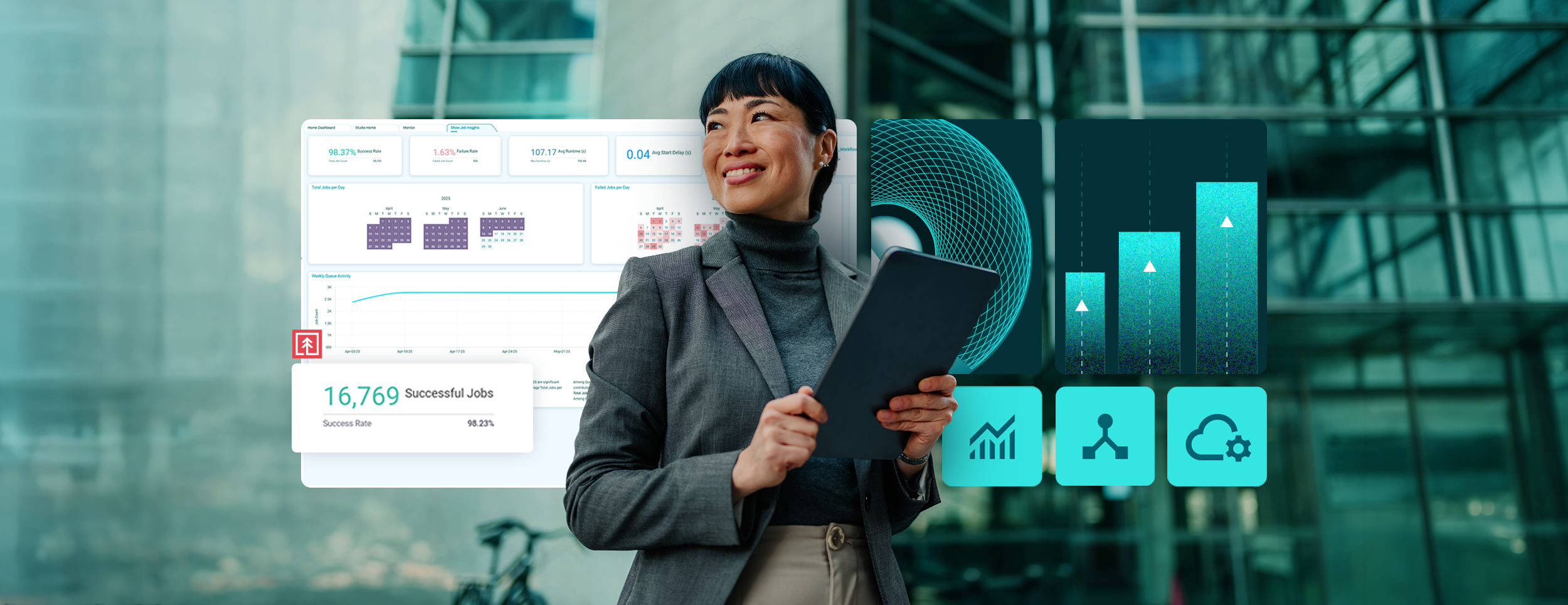
RunMyJobs tracks every deadline across the full process chain. When a step runs late in one cloud, the downstream SLA impact is calculated instantly — across AWS, Azure, Google Cloud, ERPs and on-premises systems — before anyone has to open a console.
Get predictive monitoring in a workload automation platform that works the same way, wherever your processes run.
Monitor workloads across cloud, ERP, SaaS and on-premises systems from one control plane and with one audit trail.
Validate each migration wave against its business deadlines before you switch off the source system, not after.
See process health across every cloud, so a late step in one never becomes a missed deadline in another.
Improve visibility and control of end-to-end application and data pipeline execution with SLA monitoring across hybrid cloud workflows that power mission-critical business processes.
Orchestrate SAP, Oracle, cloud platforms and partner files with SLA monitoring across your ERP landscape.
Bridge event-driven and time-based orchestration with SLA monitoring across distributed enterprise workflows.
Turn fragmented data automation silos into a governed, end-to-end execution layer in production at scale.
Capture an audit-ready record of every workflow automatically to support global compliance requirements.
Make data reliable enough to run the business by ensuring it arrives complete, current, governed and on time.
Transform AI/ML models into continuously learning systems with SLA management across data refresh and retraining workflows.

See how NGA Human Resources, serving three million employees across 100+ countries, used RunMyJobs to meet strict payroll SLAs with critical process predictive monitoring and automated recovery across complex hybrid environments.
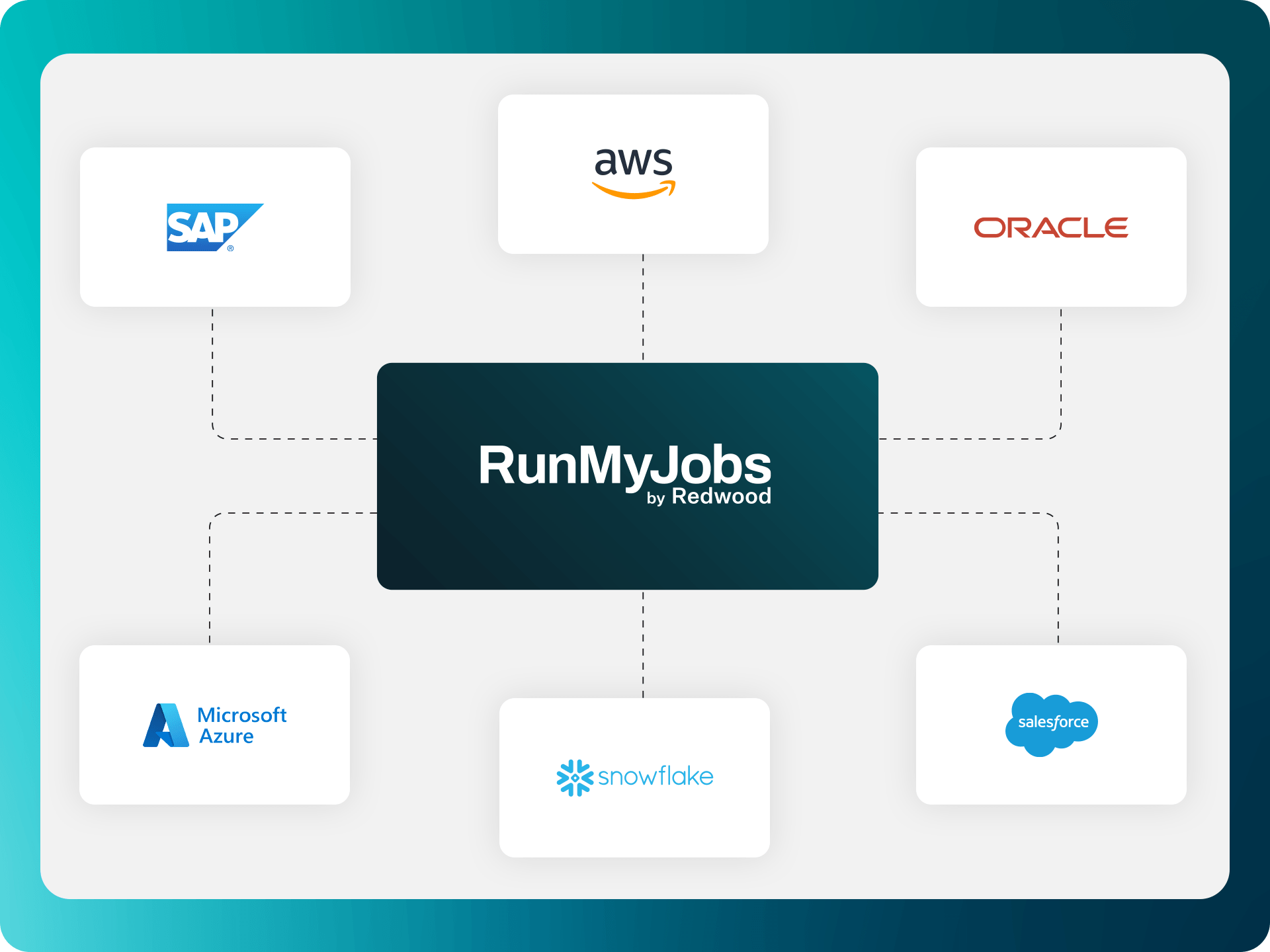
With hundreds of pre-built connectors, RunMyJobs delivers rapid out-of-the-box application, data platform and cloud services integration deployment without coding or additional infrastructure. Orchestrate hybrid cloud workflows across ERP, BI, data, AI/ML, mainframe, ITSM, observability and file transfer platforms from a single automation control plane, with SLA monitoring across your entire ecosystem.
Learn more about predictive SLA monitoring, automated remediation and enterprise workflow orchestration. Find practical guidance on moving from reactive firefighting to proactive deadline management across hybrid environments.


The three primary types of service level agreements are customer-based SLAs (between service providers and external customers), service-based SLAs (covering specific IT service delivery across multiple customers) and multilevel SLAs (combining both customer and service-based elements with tiered service quality levels). These agreements establish SLA performance metrics, uptime commitments, response time targets and operational efficiency standards across IT service management, help desk operations, customer support functions and business operations. Modern SLA tracking requires real-time monitoring tools, dashboards for performance metrics visibility and automated notifications to optimize service delivery and maintain customer satisfaction while ensuring SLA compliance across hybrid cloud and on-premises IT environments.
RunMyJobs by Redwood enables all three SLA types through predictive monitoring that tracks business deadlines rather than just technical job completion. As an enterprise-grade platform, it provides real-time dashboards and automated remediation to ensure service delivery meets committed timelines.
SLA monitoring software provides organizations with comprehensive functionality to monitor, track performance and optimize service level agreements across IT processes, customer support, help desk operations and business operations. Workload automation (WLA) platforms, or Service Orchestration and Automation Platforms (SOAPs), integrate real-time tracking capabilities, automated notifications, dashboards for performance metrics visibility and resolution time monitoring to ensure SLA compliance. Modern workload automation software supports hybrid cloud environments, IT automation processes, machine learning-driven decision-making and scalability across mainframe and IT operations. Enterprise-grade platforms offer self-service capabilities, workflow orchestration, continuous improvement features and integration with CRM systems, ITSM tools and service desk operations to optimize operational efficiency and maintain service quality standards throughout the service lifecycle.
RunMyJobs by Redwood offers SLA monitoring through AI-powered predictive analytics that identify workflow risks before business deadlines are missed. It provides automated remediation, immutable audit trails and dependency visibility across SAP, cloud platforms and legacy systems.
Predictive SLA monitoring leverages machine learning algorithms, real-time monitoring and advanced analytics to analyze historical performance metrics and identify potential issues before SLA breaches occur. These cloud-native workload automation tools monitor batch jobs, job scheduling patterns and cloud workloads across hybrid cloud infrastructure, mainframe systems and enterprise environments. The software tracks performance against established timelines, sends proactive notifications to support team members and triggers automated responses when business services are at risk of delays. This approach enhances customer and business satisfaction by maintaining service quality standards while reducing resolution time and improving operational efficiency.
RunMyJobs by Redwood uses artificial intelligence to power early warning systems that flag at-risk workflows before SLA windows close. Teams can act before business deadlines are missed with configurable thresholds, automated recovery and escalation routing to the right teams.