The business case for a modern SOAP: Where Critical Capabilities deliver real ROI
In conversations with operations, IT and architecture leaders, one question comes up most frequently: “What makes a SOAP different from our scheduler or iPaaS — and why should we invest now?”
It’s a fair question. And the answer isn’t just focused on why you should add another automation tool. Instead, considering a Service Orchestration and Automation Platform (SOAP) means you’re ready to think about the operational model behind how work moves across your organization.
A scheduler triggers tasks, an iPaaS connects applications, but a modern SOAP coordinates end-to-end business processes across systems, teams and environments in a way that maintains reliability at enterprise scale. That difference shows up directly in operational resilience, business agility and cost control.
The 2025 Gartner® Critical Capabilities for SOAP report is the clearest framework I’ve seen for tying platform strengths to financial outcomes. Here’s how I help leaders like you use that framework to build a credible business case.
The framework: Mapping Use Cases to your P&L
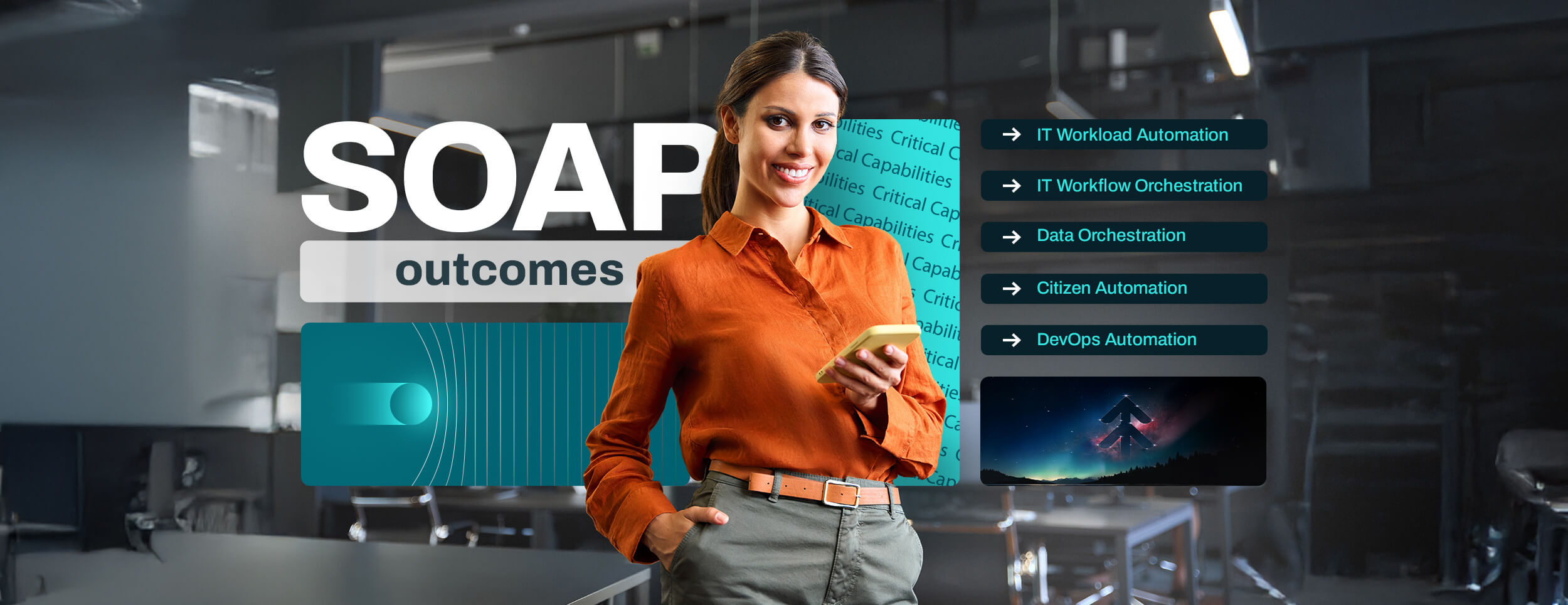
The Critical Capabilities report doesn’t start with architecture diagrams or methodology. It starts with how platforms perform against five operational Use Cases, each representing a measurable part of your business. I find these especially useful because they line up almost perfectly with the major categories of cost, risk and productivity that executives care about:
- Operational resilience
- Business agility
- Cost optimization
- Risk management
- Speed to insight
Instead of thinking of them as technical buckets, think of them as the five pillars that determine whether your automation investments actually return value. A SOAP that scores well across all five transforms automation from a technical initiative into an engine for enterprise performance.
Pillar 1: IT workload automation and the ROI of unbreakable operations
The business challenge:
A pervasive pattern I see is IT teams stuck in a reactive mode. Excessive time is spent on firefighting and manual monitoring, which draws focus away from strategic process improvement. This reactive posture results in costly consequences, including missed service-level agreements (SLAs), silent failures in critical overnight processes and a constant backlog of expensive incidents.
What this Use Case measures:
Gartner considers this the foundation of SOAPs: Can the platform run critical workloads reliably across hybrid and multi-cloud environments? Think financial close, inventory syncs, regulatory reporting — with real-time awareness and automated recovery. This means it must offer dependency management that understands system context, recovery paths that prevent cascading failures and observability that lets operators diagnose and resolve issues quickly.
Where the ROI shows up:
- Reduced downtime costs: Preventing failures before they hit the business
- Lower operational overhead: Fewer hours spent monitoring or intervening
- Strategic consolidation: Eliminating multiple schedulers, licenses and skillsets
This is the first place most organizations find real cost savings, because reliability is expensive when you’re compensating for it manually.
Pillar 2: IT workflow orchestration and the value of cross-team agility
The business challenge:
Most delays don’t come from individual tasks. They come from the handoffs: the approvals that get stuck in someone’s inbox, the data that wasn’t validated, the system that didn’t trigger the next step. Teams often automate inside their own domains but leave the gaps between them unmanaged.
What this Use Case measures:
Gartner looks at how well a SOAP can coordinate entire processes, not just tasks:
- Cross-application workflows (ERP + ITSM + SaaS + custom apps)
- Conditional logic and exception handling
- Orchestration spanning on-premises and cloud environments
Where organizations see ROI:
- Shorter cycle times: End-to-end processes move without waiting on human intervention
- Higher throughput: Fewer restarts, errors or duplicate work
- Greater adaptability: Workflows that adjust as business requirements change
The payoff is simple: people get hours back. Not to mention, change doesn’t feel risky anymore.
Pillar 3: Data orchestration and the payoff of faster, smarter decisions
The business challenge:
Analytics teams can only move as fast as the data feeding them. Many organizations are still juggling multiple disjointed ETL solutions, insecure file transfers or inconsistent handoffs between systems. The result is predictable: delays, inconsistent data and missed windows for decision-making.
What this Use Case measures:
Gartner evaluates a SOAP’s ability to orchestrate reliable, governed data pipelines:
- Event-driven movement from systems like SAP to data warehouses like Snowflake
- Managed file transfers with dependency tracking
- Data validation, reconciliation and exception handling
- Automated triggers to BI, AI or other downstream applications
Where organizations see ROI:
- Faster time-to-insight: Data arrives validated and on time
- Improved compliance: Centralized audit trails remove the risks of custom scripts with no single source of truth
- Eliminated bottlenecks: Analytics teams spend less time waiting and more time analyzing
This is where organizations often unlock value they didn’t realize they were losing.
Pillar 4: Citizen automation and the advantage of empowered teams
The business challenge:
IT teams become bottlenecks when every routine request — from report generation to onboarding steps — has to be manually actioned. The backlog grows and the business slows.
Yet handing automation directly to business users without governance isn’t an option.
What this Use Case measures:
Gartner evaluates this capability by looking at how well a platform can distribute automation safely without losing control. It’s essentially a test of whether your Operations team can create guardrails that let business users trigger approved workflows on demand without introducing risk. A strong score here reflects a platform that supports low-code execution, reusable templates and full auditability, so non-technical users can initiate routine actions while IT retains oversight. This Use Case ultimately measures how effectively a SOAP can push automation closer to the edge of the business without allowing fragmentation or shadow IT to creep back in.
Where organizations see ROI:
- Faster turnaround: Teams get what they need without waiting days or weeks
- Reduced IT ticket volume: Freeing technical staff to focus on higher-value work
- Fewer errors: Standardized workflows eliminate risky and error-prone manual steps
When done right, citizen automation is not “shadow IT.” It’s a controlled extension of enterprise automation.
Pillar 5: DevOps automation and the competitive edge of continuous delivery
The business challenge:
Software teams often automate their CI/CD pipelines but leave the surrounding processes — environment provisioning, test data setup, dependency coordination — untouched. Those manual steps are what slow releases and introduce inconsistencies.
What this Use Case measures:
For DevOps automation, Gartner focuses on how deeply the platform can integrate into modern delivery pipelines and how reliably it can coordinate the steps surrounding deployment. It’s about assessing whether automation can move at the same pace as engineering, from provisioning and testing to promotion and release. High-performing platforms demonstrate support for automation-as-code practices, event-based triggers and consistent orchestration across environments. Use these parameters to gauge a provider’s ability to remove bottlenecks from the software lifecycle so teams can deliver changes quickly without compromising reliability or governance.
Where organizations see ROI:
- Shorter release cycles: Faster, safer path from commit to production
- Higher developer productivity: Fewer manual tasks around the deployment lifecycle
- More reliable deployments: Consistency enforced across environments
This is increasingly a strategic differentiator for teams moving toward cloud-native delivery models.
An undeniable case for a strategic investment
A scheduler reduces manual effort, whereas a SOAP reduces friction across your entire operating model. When a single platform delivers across all five Gartner Use Cases, you’re not just buying automation capabilities — you’re buying:
- Fewer outages
- Faster decisions
- Higher team velocity
- Lower integration costs
- Stronger risk posture
- A future-proof automation foundation
This is the business case every CFO wants: clear outcomes tied to operational, financial and strategic value. The next time you evaluate platforms, don’t ask, “What does it automate?” Ask, “Where does it impact my P&L?”
That’s the difference between a tool and a transformation partner.
Evaluate SOAP vendors with our scorecard, and download the full Gartner Critical Capabilities report to compare how leading platforms perform against these five essential Use Cases.
About The Author

Nick Totero
Nick Totero is a Senior Manager of Solutions Engineering at Redwood Software. He’s been with the company for seven years and is responsible for leading the Pre-Sales organization in new and expansion business development. Nick has, in part, been responsible for growing the Solutions Engineering team from a one-person operation at the start of 2020 to 30-plus as of 2025. He’s also a certified Demo2Win presenter and Automation Expert.

