Integrate AWS EKS with RunMyJobs
 Authored by
Redwood Software
Authored by
Redwood Software
Scale and patch your Amazon Elastic Kubernetes Service (EKS) node groups. Then submit, monitor and clean up Kubernetes Jobs with the same scheduling, dependency tracking and audit trail you already use in RunMyJobs by Redwood.

Overview
Manage Amazon EKS node group capacity and Kubernetes workloads as part of your everyday automation, instead of scripting around kubectl or building a separate integration layer.
Use the Amazon EKS connector for RunMyJobs to schedule compute capacity alongside your batch work, so node groups scale before a window opens and stay patched between windows. When a Kubernetes Job fails, you can retrieve its logs in RunMyJobs and re-run it there instead of opening the cluster.
Start with the Kubernetes Jobs you already run and convert them into ready-to-run job definitions, so nothing needs rebuilding.
Key features
- Scale node group capacity for compute-intensive batch windows
- Patch node group Amazon Machine Image (AMI) and Kubernetes versions on schedule
- Submit and monitor Kubernetes Jobs with automatic log capture
- Clean up and bulk-import Kubernetes Jobs by filter
Integration type

Use Cases
Learn more & support
- Contact Support
- Documentation
-
 Published to the Catalog
Security & Compliance
Other Infrastructure Integrations

Simple Queue Service (SQS)
Send, receive and manage AWS SQS messages directly from RunMyJobs job chains to make messaging a first-class, fully observable step in your enterprise automation with built-in retry handling and centralized credential management.- Infrastructure
-
EventBridge
Publish events, manage rules and coordinate cross-account event routing directly from RunMyJobs job chains to make your automation workflows a first-class participant in AWS event-driven architectures with a full audit trail and no custom scripting.- Infrastructure
-
Lambda
Trigger AWS Lambda functions from any business event. Connect serverless computing to your core enterprise applications for true cross-platform control.- Infrastructure
-
Glue
Orchestrate your serverless data integration workflows by seamlessly embedding AWS Glue ETL jobs and crawlers into your end-to-end business processes for complete, automated control over your data pipeline.- Infrastructure
Other AWS Integrations
-
ECS
Explore how this AWS integration runs, scales and monitors ECS tasks on Fargate or EC2 as dependency-chained, auditable steps in RunMyJobs.- Service Management
-
RDS
Explore how this AWS integration runs RDS/Aurora SQL, manages snapshots and automates availability windows as auditable steps in RunMyJobs.- Service Management
-
Managed Workflows for Apache Airflow (MWAA)
Trigger, monitor and manage Amazon MWAA Airflow DAG runs directly from RunMyJobs process chains to bring your AWS data pipelines into one enterprise automation strategy without custom scripts or Lambda workarounds.- Data Management
-
Simple Queue Service (SQS)
Send, receive and manage AWS SQS messages directly from RunMyJobs job chains to make messaging a first-class, fully observable step in your enterprise automation with built-in retry handling and centralized credential management.- Infrastructure
Related Resources

Top SaaS automation solutions for SAP environments
Explore the benefits of SaaS workload automation, and discover which platforms best fit your organization’s SAP environments.

What you need to know about cloud orchestration and automation tools
The world is projected to produce 221 zettabytes of data in 2026, and a growing share of it will live in the cloud. This presents a major challenge: Despite the benefits cloud services deliver to businesses, including reliable scalability, flexibility in providing new services and the ability to quickly deploy new technologies, they drive up the requirements for managing and monitoring lots of processes, tasks and systems. As adoption of new cloud technologies increased the number of management tasks that had to be performed by IT,
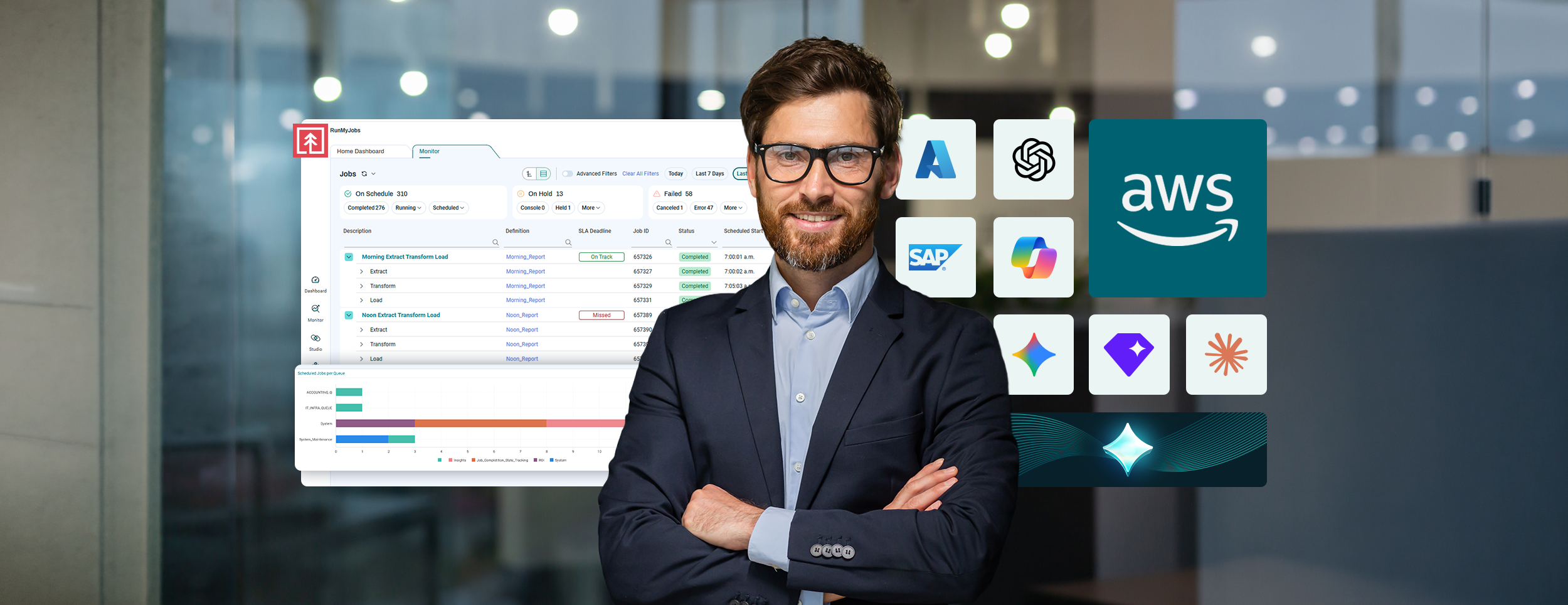
What happens at the edges of your AWS workflows: 3 ways to extend RunMyJobs
Extend the dependency control, SLA monitoring and operational visibility you already use in RunMyJobs across AWS, SAP and on-premises systems. See how that foundation can also support governed agentic execution when a workflow needs judgment.

When somebody’s cron job is your AWS orchestration strategy
Relying on scheduled polling scripts to connect SAP and other enterprise systems to AWS workloads compromises data accuracy and slows resolution times. See how unified enterprise orchestration provides real-time visibility, strengthens governance and optimizes cloud spending.