6 ways Redwood customers outperform peers in automation

Everyone’s investing in automation. So why are some organizations seeing sky-high returns, while others are stuck in neutral?
The answer isn’t just which tool you choose. It’s how deeply you integrate it, how broadly you scale it and how intentionally you manage its applications.
Most enterprises today are under constant pressure to do more with less and do it faster. And they’ve landed somewhere between mere implementation and realization of its ultimate potential value. Redwood Software’s “Enterprise automation index 2026” shows that 61% of automation teams are underutilizing their automation tools, and fewer than 6% have achieved autonomous processes. That represents an enormous missed opportunity for operational gains — and, critically, AI enablement.
Redwood works with some of the most forward-thinking enterprises in the world. When we looked at the data, a clear pattern emerged. Redwood customers consistently outperform the average enterprise across key metrics that matter: efficiency, cost reduction, AI readiness and beyond. Here’s what they’re doing differently and why this matters if you’re looking to optimize the impact of automation on your organization going forward.
1. They turn automation into outcomes
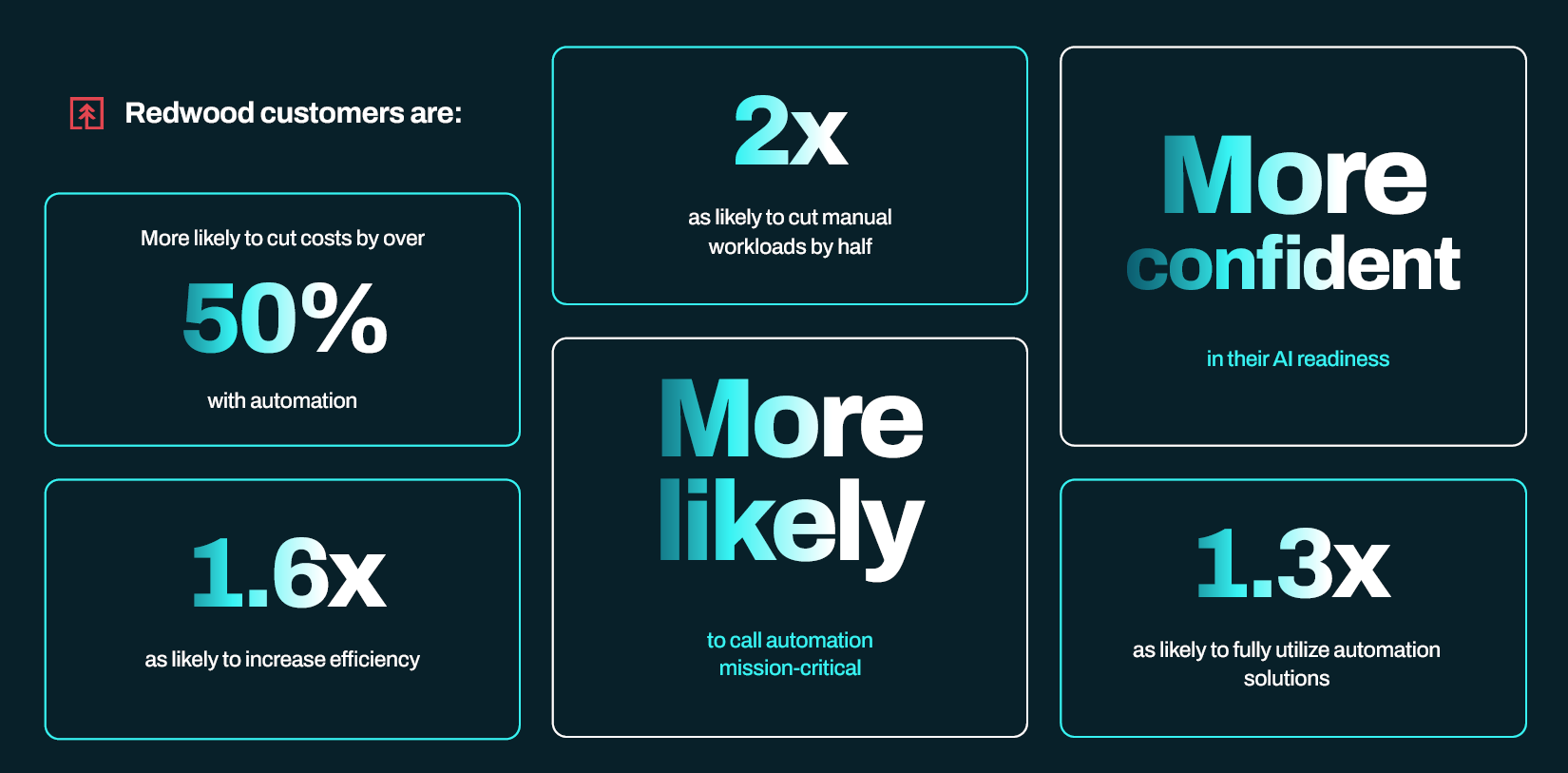
Redwood customers are 1.3x as likely as other automation users to report full utilization of automation solutions.
While most organizations own automation software, far fewer use it to its full potential. Underutilized tools create a false sense of progress: you’ve bought automation, but your workflows still depend on human intervention, tribal knowledge and disconnected systems.
Redwood’s automation fabric model focuses on full-cycle success. That means reaping maximum ROI in deployment, adoption and sustained optimization. Through 24/7 support, a dedicated Customer Success team, on-demand training, integration depth and cross-functional rollout strategies, Redwood customers move beyond implementation to impact.
🛠️ Pro tip: Ask your own teams how many workflows, processes or departments are truly automated end to end. If the number is low, you have a utilization gap.
2. Efficiency is their baseline — not a bonus
Redwood customers are 1.6x as likely to report measurable efficiency gains.
Everyone wants better throughput, fewer delays and less time wasted in handoffs. But only some organizations actually get there—and the difference isn’t the use case; it’s the orchestration.
Redwood customers are more successful in this area because they go beyond automating isolated tasks. They automate how those tasks connect across ERP, SaaS and custom applications. It follows that they experience fewer data silos, faster cycles and real-time responsiveness.
🔁 Efficiency tip: If your automation is still bound to static schedules or buried in silos, you’ll hit a wall. Redwood enables event-driven, conditional workflows that adapt to what’s happening in real time.
3. They cut manual work in half twice as often
Redwood customers are 2x as likely to say automation helped them cut manual workloads by 50% or more.
Manual work remains one of the biggest drains on enterprise agility. But Redwood customers have managed to overcome this barrier, and not with small wins like automating password resets. We’re talking about reducing repetitive work across entire business processes, like closing the books in finance or reconciling inventory in retail.
Redwood customers’ strengths lie in how they orchestrate across systems, not just inside them. That means fewer human handoffs and errors and much more time spent on value-added tasks.
💡 Leadership lens: Want to boost employee satisfaction and reduce risk at the same time? Automate the work people shouldn’t be doing manually anymore.
4. They’re seeing serious cost savings
1 in 3 organizations sees a 25% cost cut, but Redwood users reach 50% and beyond.
Automation isn’t just a performance play. It’s a financial one. Redwood customers win here, too, by minimizing unplanned downtime, eliminating script maintenance, reducing manual effort for routine ops and avoiding expensive workarounds.
🎯 Budget tip: Don’t chase savings through individual point solutions. Look at your entire automation fabric — where inefficiencies live and what systemic improvements are possible.
5. AI readiness is their competitive advantage
Nearly 40% of automation teams aren’t ready for AI, but Redwood customers feel well-positioned to take advantage of it.
Everyone’s talking about AI, but few organizations have the operational maturity to support it. That’s what makes Redwood’s automation foundation different.
AI depends on timely data, orchestrated systems and reliable execution layers. Redwood customers are more likely to say they’re ready for AI because they’ve already done the hard work of integrating automation into their infrastructure and processes.
⚙️ Readiness check: Before launching any AI initiative, ask: Can we trust our underlying processes to deliver clean data, fast execution and secure handoffs? If not, Redwood can help get you there.
6. They treat automation as a business strategy
Redwood customers are more likely to call automation mission-critical.
Cultural buy-in sets the ceiling for automation success. Redwood customers don’t treat automation as an IT line item.
An automation-as-business-strategy mindset shapes how they invest, what they prioritize and how they scale. It’s also why they’re more likely to deliver outcomes that matter, such as improved service levels, business resilience and innovation capacity.
📊 Alignment insight: stand out from your peers by shifting the conversation from “What should we automate?” to “How can automation support our biggest goals?”
Don’t get caught in the automation gap
What stood out in our data was not just how much Redwood customers automate but how strategically they do so. Orchestration turns good automation into great outcomes.
But it’s become clear that the gap between automation investment and successful adoption isn’t closing — it’s widening. And as AI accelerates, that gap will only become more consequential.
Redwood customers outperform not because they bought a better tool, but because they committed to a smarter approach of making automation a foundation, not a feature.
Read more about what your peers are achieving — and challenged by — in enterprise automation. Download the full report.
About The Author

Sami Zeitoun
Sami Zeitoun, VP of Technology Solutions and Customer Success at Redwood Software, has over two decades of experience helping organizations leverage technology to drive efficiency, scalability and meaningful business outcomes. Sami works closely with global organizations to strengthen their automation foundations, focusing on scaling adoption, orchestrating across complex systems and preparing for AI-driven innovation. He is particularly passionate about closing the gap between automation investment and tangible business impact.
Throughout his career, Sami has held senior roles across engineering, pre-sales and customer-facing functions. His background combines deep technical expertise with a proven track record of fueling product innovation and go-to-market success in both established companies and high-growth environments. This multifaceted experience allows him to align technical execution with the strategic operational needs of Redwood’s customers.

