Enterprise workload automation platforms for ERP
Find out which leading enterprise workload automation platforms orchestrate best across your organization’s ERP systems.
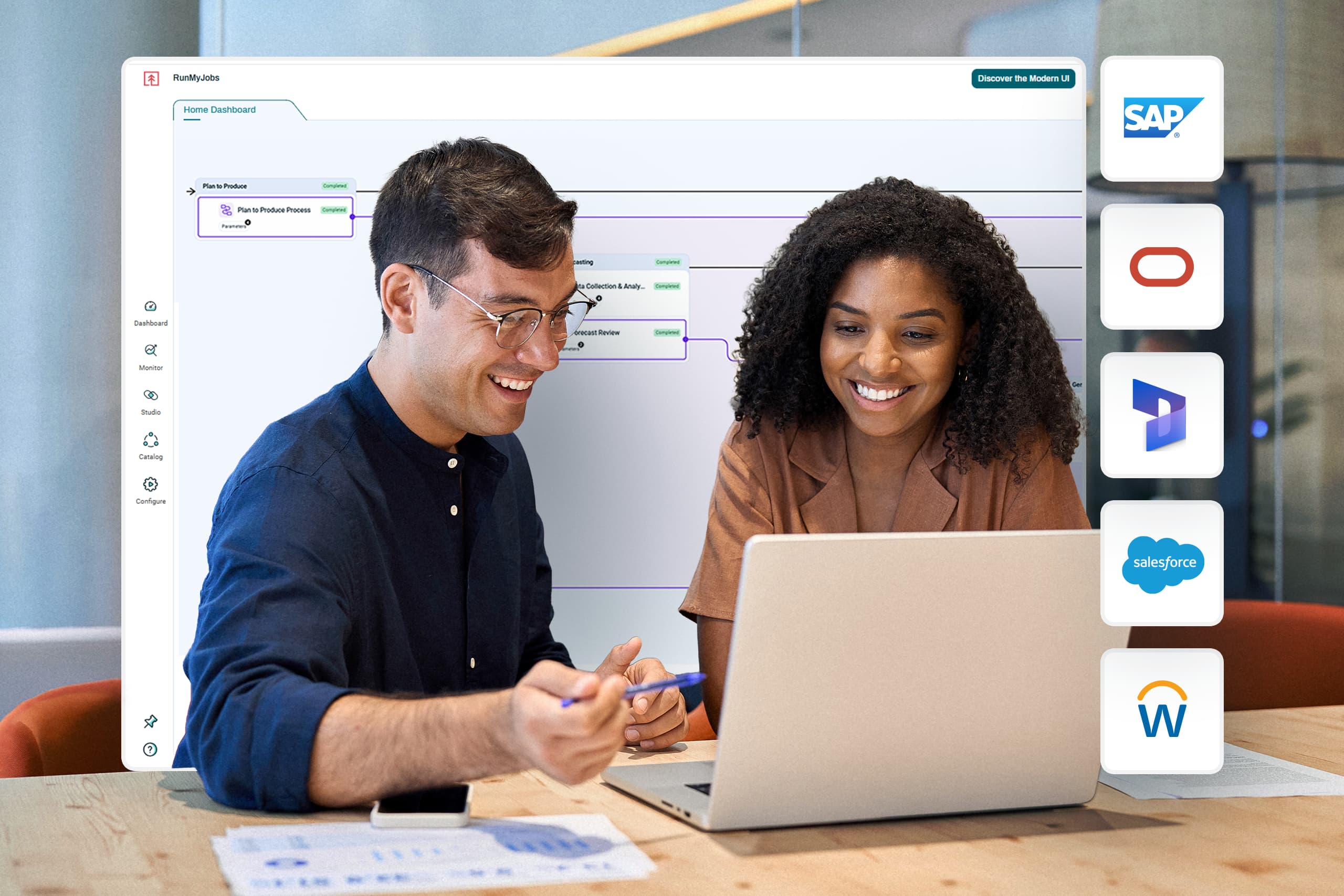
Overview
A decade ago, ERP automation mostly meant scheduling batch processing workloads inside one system. That’s no longer how large enterprises operate. Most run SAP alongside Oracle, Microsoft Dynamics, Infor, Workday, Salesforce, NetSuite, several databases and a growing list of cloud platforms, and each of those systems generates its own batch jobs, ETL and other data pipelines and business processes that need to run on schedule and in the right order.
Enterprise workload automation (WLA) has become the control layer that ties those systems together and supports broader digital transformation initiatives. Instead of a separate scheduler for every application, one platform manages job dependencies, data pipeline orchestration, event-driven automation and end-to-end business process automation across the entire ERP setup. Learn more about the leading enterprise automation platforms for ERP systems, what each one does well and what you should evaluate before choosing one.
Quick overview: Top enterprise workload automation platforms
| Platform | Primary use case | ERP deployment model | Key integration strengths |
|---|---|---|---|
| RunMyJobs by Redwood | Cross-ERP and cross-application orchestration (SAP, Oracle, Dynamics, Salesforce, Workday and more) | SaaS, agentless | The only SAP Endorsed App in the workload automation category; certified SAP integrations, plus Oracle and hundreds of other connectors |
| BMC Control-M | Cross-ERP orchestration (SAP plus Oracle plus PeopleSoft) | On-premises or SaaS | 500-plus integrations; dedicated SAP, PeopleSoft and Oracle EBS plug-ins |
| Broadcom Automic | SAP-certified orchestration across hybrid mainframe-to-cloud ERP environments | SaaS or self-managed | Multiple SAP ICC certifications; Kubernetes and OpenShift-native |
| Stonebranch | Real-time, event-driven SAP and non-SAP ERP orchestration | On-premises, containerized or SaaS | SAP-certified for S/4HANA and RISE; HONICO ABAP add-on |
| Beta Systems ANOW! | Hybrid IT and mainframe-adjacent SAP orchestration | On-premises or hybrid; listed on SAP Store | 500-plus integrations; SAP R/3 through BTP coverage |
| Broadcom AutoSys | SAP migration continuity for existing AutoSys customers | On-premises or cloud (VM-based; no native SaaS) | Deep SAP, PeopleSoft and Oracle EBS application support |
Compare automation platforms
Leading enterprise automation platforms for ERP systems
Enterprise WLA platforms vary in their ERP coverage, deployment models and orchestration capabilities. Explore each platform’s strengths, integrations and how they fit across cloud and on-prem infrastructure, including complex hybrid environments.
RunMyJobs by Redwood
Best for
Enterprises standardizing on one orchestration layer across SAP and other ERP, CRM and HCM systems instead of stitching together point schedulers
Overview
RunMyJobs is the leading orchestration platform for the enterprise, driving business transformation at the lowest total cost of ownership (TCO). Organizations use it to intelligently automate and orchestrate mission-critical business and IT processes across complex ERP, hybrid cloud, data and emerging agentic AI systems.
Key capabilities
- Event-driven triggers, including file arrivals, API calls and queue messages, plus reusable business calendars for complex recurrence patterns
- A Connector Wizard for building new integrations through custom REST API connections in minutes with no scripting required
ERP integrations
- Certified SAP integrations, including S/4HANA and RISE, plus Oracle and mainframe connectors out of the box
- Positioned as the orchestration layer across ERP systems, including SAP S/4HANA, SAP ECC, Oracle ERP and Microsoft Dynamics, along with CRM systems such as Salesforce and Dynamics CRM and HCM systems such as Workday and SAP SuccessFactors
Cloud capabilities
- An enterprise-grade SaaS platform with a 99.95% uptime SLA
- An agentless architecture with lightweight local agents that update automatically, with no on-premises hardware or perpetual licenses to manage
- Built-in connectors for AWS, Databricks, ServiceNow and hundreds of others
BMC Control-M
Best for
Large enterprises running SAP alongside Oracle E-Business Suite, PeopleSoft or mainframe ERP workloads that need one control plane
Overview
Control-M is an application and data workflow orchestration platform available as SaaS or self-hosted and serves as a layer that sits above ERP systems, instead of replacing native schedulers.
Key capabilities
- 500-plus out-of-the-box integrations, dependency management and SLA-based alerting with automated recovery
- A Control-M Archive Service for audit-ready historical job data
ERP integrations
- Dedicated plug-ins for SAP (ECC, S/4HANA, BW), Oracle E-Business Suite and PeopleSoft
Cloud capabilities
- Native orchestration for AWS, Azure and Google Cloud, including AWS Lambda, Step Functions and Azure Data Factory
- Available as SaaS or self-hosted deployment
Broadcom Automic
Best for
Enterprises orchestrating SAP alongside a wide mix of ERP, cloud and mainframe applications that want a single automation engine with deep SAP certification
Overview
Delivered as SaaS or a self-managed solution, Automic orchestrates complex workflows and integrates hybrid systems across the SAP landscape.
Key capabilities
- Multi-tenancy, role-based access control and immutable audit trails across every automation object
- Predictive analytics and SLA and SLO monitoring with automated remediation
ERP integrations
- Certified integrations for SAP S/4HANA, RISE with SAP, SAP BTP, SAP BusinessObjects BI and SAP IBP
Cloud capabilities
- Native support for Kubernetes, OpenShift and serverless environments, plus multi-cloud orchestration across AWS, Azure and Google Cloud
- Delivered as SaaS or self-managed
Stonebranch
Best for
Organizations consolidating SAP and non-SAP ERP scheduling into one real-time, event-driven platform
Overview
Stonebranch’s Universal Automation Center (UAC) orchestrates tasks and processes across hybrid IT environments in real time and is available on-premises, containerized or as SaaS.
Key capabilities
- Includes event-driven automation
- Features an AI-powered assistant
- Centralizes governance across hybrid IT environments
ERP integrations
- SAP-certified for S/4HANA and RISE with SAP S/4HANA Cloud, deepened by the 2025 HONICO acquisition and its SAP NetWeaver ABAP add-on
Cloud capabilities
- Integrates across public cloud systems like AWS, Microsoft Azure and Google Cloud
- Contains pre-built integrations to link to disparate cloud applications
Beta Systems ANOW!
Best for
Organizations modernizing mainframe-adjacent SAP and hybrid IT scheduling that want a single control plane across R/3, ECC, RISE and BTP
Overview
ANOW! is a workload automation and orchestration platform that coordinates business processes across hybrid IT landscapes and is available on the SAP Store.
Key capabilities
- Centralized monitoring, event-driven automation and governance through audit trails, SLA management and policy-driven automation
- 500-plus out-of-the-box integrations across cloud, on-premises and mainframe (z/OS)
ERP integrations
- Integrates with SAP R/3, ECC, S/4HANA (on-premises and cloud), RISE and BTP
- Connects with Oracle PeopleSoft for payroll and financial close processes
Cloud capabilities
- Native integrations with Azure Data Factory, AWS Glue, Talend and Databricks for hybrid and multi-cloud data pipelines
Broadcom Autosys
Best for
Financial services and banking organizations with an established AutoSys footprint that are migrating ERP workloads to S/4HANA without a platform swap
Overview
AutoSys is S/4HANA-ready and oriented toward visibility and control of workloads across platforms, ERP systems and the cloud.
Key capabilities
- Built-in audit support and tracking features
- Secure role-based administration
- Predictive machine-learning-based risk detection through automation analytics and intelligence
ERP integrations
- Extensive application support for SAP, PeopleSoft and Oracle E-Business Suite
Cloud capabilities
- Dynamic workload placement across physical, virtualized and cloud environments, with no native SaaS delivery model
Top WLA features
What separates the best enterprise workload automation platforms?
The strongest WLA platforms do more than schedule jobs. They connect systems, respond to real-time events and provide the governance, scalability and observability needed to manage complete business processes across a complex technology estate. Real-time monitoring and anomaly detection help teams identify delayed or failed workflows before they affect downstream systems.
Prebuilt ERP integrations
Native connectors for SAP, Oracle, Dynamics or other ERP systems cut implementation time considerably compared with building custom scripts or service orchestration and automation platform (SOAP)-based interfaces for every job step.
Real-time ERP job scheduling
Event-based triggers, business process orchestration and dependency management let a platform respond to what’s happening across systems in real time instead of running on a fixed clock. Platforms should also support service level agreements through centralized SLA monitoring and escalation.
Cross-platform orchestration
The strongest platforms extend past ERP into cloud infrastructure, ETL and data warehousing workflows, data platforms such as Databricks, Hadoop or SQL Server, managed file transfer (MFT) and general IT operations, so a single job chain can span SAP, a data warehouse and a downstream reporting tool.
Governance and compliance
Audit trails, role-based access control and policy enforcement support regulatory compliance as automation touches more regulated processes, particularly for organizations working under frameworks such as GDPR. Version-controlled jobs-as-code capabilities can also strengthen governance and simplify automation lifecycle management across development, test and production environments.
Enterprise scalability
High availability, global scheduling and multi-region deployments determine whether a platform can coordinate workloads across distributed computing resources as an enterprise adds new business units, acquisitions or ERP instances. Strong resource management also helps prevent critical ERP workloads from competing for capacity.
Choose a platform
How to choose an enterprise automation platform
The right platform depends on the systems an enterprise runs, the processes it needs to coordinate and the infrastructure it plans to support. Evaluating integration coverage, end-to-end orchestration, deployment flexibility and migration requirements can help narrow the options.
Does it support all the ERP systems you run?
Most enterprises aren’t running a single ERP. Confirm certified integrations for SAP, Oracle and any other core systems, such as JD Edwards, before assuming a platform will fit.
Does it automate complete business processes?
A platform that only schedules individual jobs still leaves the coordination between systems to someone on your team. Look for orchestration that spans the full process, not just each job step in isolation.
Does it support hybrid cloud?
Check whether the platform runs as SaaS, public cloud, private cloud or on-premises, and whether it can mix those models as your infrastructure changes.
How difficult is migration?
Moving off an existing scheduler or legacy automation tool carries operational risk. Ask vendors directly about typical migration timelines and what happens to existing job documentation during the switch.
Replace isolated schedulers
Why enterprises are replacing isolated ERP schedulers
Running separate automation tools for SAP, Oracle, a data warehouse and various cloud services creates its own overhead. Multiple automation tools mean multiple places to check when something breaks, and visibility gaps between them slow root-cause analysis. Manual coordination, someone watching one system and manually kicking off a job in another once the first finishes, doesn’t scale as the number of connected systems grows. Compliance challenges follow the same pattern. Proving an end-to-end audit trail across five disconnected schedulers is harder than pulling one from a single platform. And every extra tool adds its own licensing, maintenance and operational costs, which is often the detail that finally pushes IT automation and workload automation software decisions to the top of the priority list.