Why enterprises are replacing one-size-fits-all automation with a tailored cloud orchestration platform
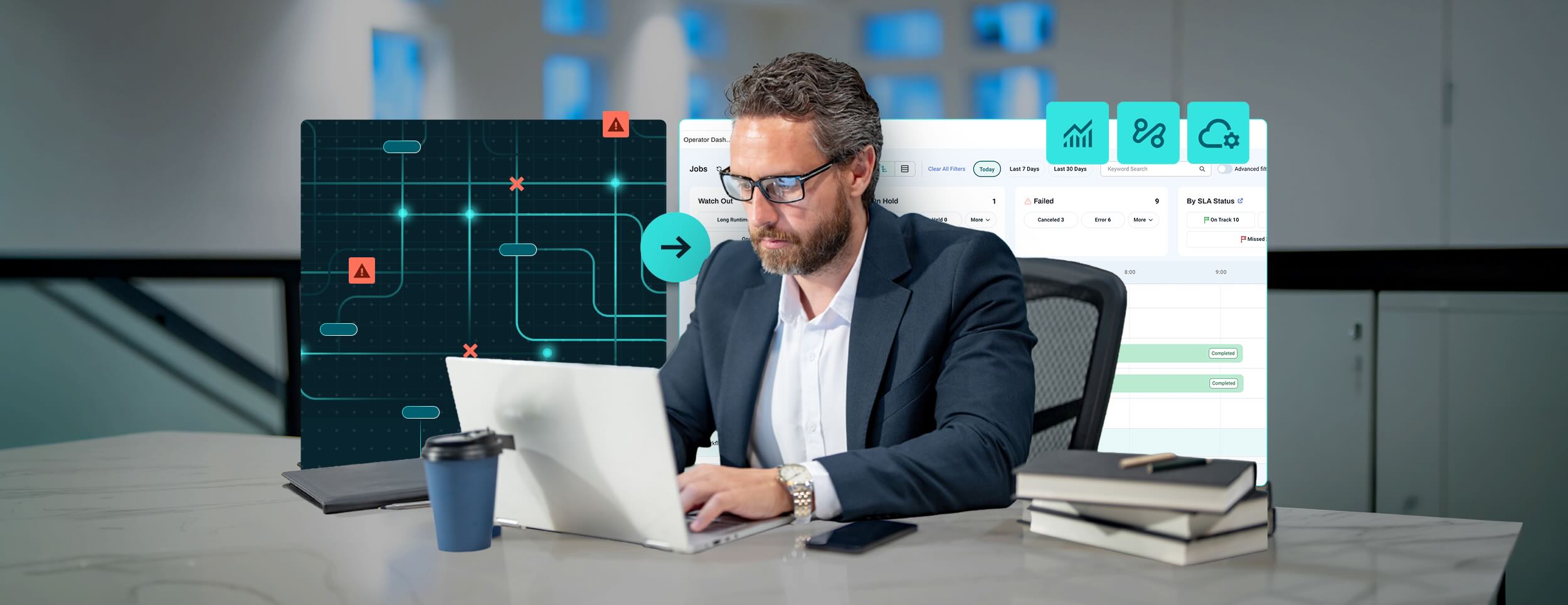
For about 30 years, enterprise automation ran on standardization. You bought a scheduler, and your processes learned to live inside its limits. When every workload sat in one data center, that trade felt reasonable.
It doesn’t anymore. Your environment now spans on-premises servers, Amazon Web Services (AWS) and SAP, but no single template fits all three. A cloud orchestration platform earns its place by fitting your systems and processes without custom code or a drawn-out implementation. That’s tailored orchestration. Redwood Software builds automation that adapts to your business needs instead of asking you to adapt to it.
Why do fixed job schedules break down after an SAP migration?
Consider GROWMARK, a large agricultural cooperative with several business units. When it moved to SAP, it ran its batch jobs on SAP’s native task scheduler and everything else on a separate on-premises scheduler. Teams coordinated the two by timing: they scheduled an SAP job for three minutes past the hour and a downstream job for 23 minutes past the hour.
That timing broke down in a specific way. When an SAP job ran long without failing, the downstream job still started on schedule, found no output and reported success. Someone had to notice that the downstream job finished too fast.
Automation once meant doing more with fewer people. The goal now is fitting it to your business needs, your systems and your compliance rules. For IT leaders, that shows up in the cloud bill and in every AI roadmap review.
What tailored orchestration means
Tailored orchestration is automation that adapts to your systems and compliance needs instead of forcing your operations into a fixed template. Packaged automation, by contrast, only removes manual work inside one application.
The old model assumed there was a standard process to automate, but there wasn’t one. Every enterprise runs its own mix of applications, service-level agreements (SLAs), compliance requirements and handoffs between teams. Traditional job scheduling handled that variety by ignoring it. It squeezed processes into a fixed template, and the workarounds piled up as technical debt.
A cloud orchestration platform does the adapting, and your workflows reflect how your operations actually run. You design workflows around how your business actually operates.
What is breaking fixed schedulers in hybrid environments
Most enterprises run automation across a patchwork of tools: one scheduler for SAP, another for cloud workloads and a layer of scripts holding it all together. That patchwork is expensive to maintain and easy to break. Schedules copied unchanged from the data center keep polling scripts and always-on hosts running in the cloud, and Flexera’s 2026 State of the Cloud Report puts estimated wasted cloud spend at 29%, the first increase in five years.
The cause is structural. Hybrid and multi-cloud environments have outgrown schedulers built around a single data center. Custom middleware is no longer the default way to connect an application, service or server. RunMyJobs by Redwood offers prebuilt integrations for 500+ technologies, so the scripts that hold the patchwork together are no longer your only option.
According to Redwood’s 2026 Enterprise Automation Benchmark Report, 68.8% of leaders say automation is mission-critical to business success, but just 10% prioritize its adoption. Most organizations already know automation matters. Complexity and a lack of orchestration are the barriers to successful automation adoption.
What tailored orchestration looks like across SAP and hybrid environments
GROWMARK chose RunMyJobs and rebuilt its jobs one at a time instead of migrating them automatically, so the team could clean up as it went. It moved its SAP processes first and then recreated the rest. The move also became a process optimization exercise: the team dropped about a third of its legacy jobs because they were redundant or unused. In some cases, one job now does what three did. The team wanted to see every job in one view and have later jobs recognize the status of earlier ones, and RunMyJobs delivered both.
Kaeser Compressors shows the same idea at global scale. After moving its SAP automation to RunMyJobs as software as a service (SaaS), Kaeser no longer builds a separate process for each country, and a single automated process chain now supports more than 40 countries.
RunMyJobs applies the same approach to hybrid environments through three capabilities:
- Event-driven triggers: Starts a process chain when a file lands, using native S3, EventBridge and AWS Glue connectors, so no polling script runs on a timer
- Redwood Insights: Adds root-cause analysis and historical trend views, while predictive SLA monitoring flags at-risk processes before they miss a business deadline
- Redwood RangerAI: Analyzes failures and suggests the likely fix through the Product Assistant, and generates scripts and documentation through the Automation Co-pilot
How RunMyJobs delivers tailored orchestration
These capabilities are why Redwood believes it has been named a Leader in the Gartner® Magic Quadrant™ for Service Orchestration and Automation Platforms (SOAP) for three consecutive years, most recently in 2026, and positioned furthest for Completeness of Vision.
Agentless architecture
RunMyJobs automates workloads across cloud and on-premises systems without installing an agent on each one. That leaves less for you to maintain, and upgrades happen without downtime. The platform has run more than 50 billion automations and guarantees 99.95% uptime.
Event-driven execution
Time-based batch windows made sense when everything ran overnight. Event-driven triggers let a workflow start when something actually happens, such as when a file lands, an API call comes in or a transaction completes. Your processes run on your business’s schedule, not the scheduler’s. On AWS, RunMyJobs triggers workflows from services such as Amazon EventBridge and Amazon SQS, so workloads start the moment work arrives instead of waiting for a polling script to check.
SAP automation
RunMyJobs is an SAP Endorsed App and the only workload automation solution in the RISE with SAP reference architecture. It connects to S/4HANA, SAP Cloud ERP and SAP Business Technology Platform (BTP). Redwood also validated its Model Context Protocol (MCP) server with SAP Joule.
That matters most during a move from SAP ERP Central Component (ECC) to S/4HANA. Many teams rebuild their automation during the migration anyway, which makes it the natural time to replace fixed schedules with event-driven workflows.
Governed agentic orchestration
Redwood’s agentic orchestration runs AI agents inside governed workflows, so you can see what each agent is doing and keep a person in the loop. RunMyJobs makes every agentic action traceable and auditable, and deterministic guardrails limit what an agent can touch in production. Its MCP server integrates your existing workflows with third-party AI models and agents, including Microsoft Copilot, SAP Joule and Claude Code.
Cloud adoption offers a useful parallel. Companies that held out on cloud infrastructure didn’t fail overnight, but they moved more slowly than their competitors for years afterward. Orchestration is heading the same way. Teams that skip it will keep maintaining scripts while their competitors free up time to work on more value-driven work.
How fast are enterprises moving to tailored orchestration?
Cloud migration took about a decade to go mainstream. Adoption will move faster for two reasons.
The first is SAP’s maintenance timeline. Mainstream maintenance for SAP ECC ends on December 31, 2027, and extended maintenance runs through 2030 at an added cost. Teams moving to S/4HANA are revisiting the schedulers behind their SAP jobs, which makes the migration a natural point to drop rigid tools.
The second is AI. In Redwood’s 2026 enterprise benchmarks in AI and agentic orchestration research report, 81% of the respondents’ employees use AI daily, yet only 30.3% of the respondents report a mature AI strategy. Each new AI agent increases demand for workflows that adapt without losing governance.
Questions to ask about your current automation
- How much of your automation budget goes to keeping brittle scripts alive?
- When a process changes, can your team update the workflow in hours, or does it turn into a project?
- If AI agents start working inside your processes next quarter, will you be able to see and govern what they do?
- When a job fails across AWS and SAP, can you trace the cause without opening three consoles?
- Does your automation fit your requirements, or have you bent your processes to fit it?
- Can you see every job and dependency across on-premises, cloud and SAP from one place, or does your team have to check several tools?
If two or more of your answers concern you, your automation shapes your processes instead of the reverse. Start evaluating at least 12 months before your scheduler contract renews. With fewer than nine months left, the renewal date forces the decision.
Where to start with tailored orchestration
How quickly your organization moves depends on your industry and how aggressively you retire legacy tools. RunMyJobs connects SAP, AWS and on-premises systems through one SaaS platform, so you can start with the workflows that cost the most to maintain and extend from there. You keep the automation that works and tailor the rest.
See how your automation strategy compares in Redwood’s latest research, or request a demo to map your first tailored workflows.